


Page 131 - 摩擦学学报2025年第10期
P. 131
1528                                   摩擦学学报(中英文)                                        第 45 卷

                                       z/μm                           z/μm                             z/μm
                 (a)                     2.52  (b)                      1.94 (c)                        3.38


                                         −22.16                         −4.75                           −2.87
                                         2.524                                                           2.524
             1.893                    1.893  1.893                   1.893 2.524  1.893               1.893
               1.420               1.262      1.420                            1.420               1.262
                                                0.947
                  0.947         0.631  y/mm  x/mm                1.262 y/mm       0.947                y/mm
                     0.473                         0.473      0.631            x/mm  0.473     0.631
               x/mm
                 (a1)     0 0                  (b1)     0 0                 (c1)          0 0


                 20.5 μm                            4.6 μm                       1.8 μm


                                        200 μm                      200 μm                        200 μm

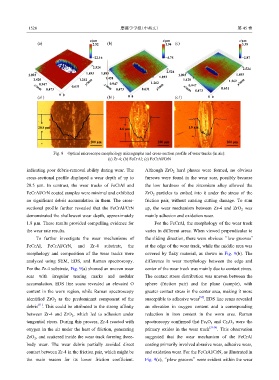
                        Fig. 8    Optical microscope morphology micrographs and cross-section profile of wear tracks (in air):
                                               (a) Zr-4; (b) FeCrAl; (c) FeCrAl/CrN

            indicating poor debris-removal ability during wear. The  Although  ZrO   hard  phases  were  formed,  no  obvious
                                                                           2
            cross-sectional  profile  displayed  a  wear  depth  of  up  to  furrows were found in the wear scar, possibly because
            20.5  µm.  In  contrast,  the  wear  tracks  of  FeCrAl  and  the  low  hardness  of  the  zirconium  alloy  allowed  the
            FeCrAl/CrN coated samples were minimal and exhibited  ZrO   particles  to  embed  into  it  under  the  stress  of  the
                                                                  2
            no  significant  debris  accumulation  in  them.  The  cross-  friction  pair,  without  causing  cutting  damage.  To  sum
            sectional  profile  further  revealed  that  the  FeCrAl/CrN  up,  the  wear  mechanism  between  Zr-4  and  ZrO   was
                                                                                                        2
            demonstrated the shallowest wear depth, approximately  mainly adhesion and oxidation wear.
            1.8 µm. These results provided compelling evidence for  For the FeCrAl, the morphology of the wear track
            the wear rate results.                             varies in different areas. When viewed perpendicular to
                To  further  investigate  the  wear  mechanisms  of  the sliding direction, there were obvious “low grooves”
            FeCrAl,  FeCrAl/CrN,  and  Zr-4  substrate,  the   at the edge of the wear track, while the middle area was
            morphology  and  composition  of  the  wear  tracks  were  covered  by  flaky  material,  as  shown  in  Fig.  9(b).  The
            analyzed  using  SEM,  EDS,  and  Raman  spectroscopy.  difference  in  wear  morphology  between  the  edge  and
            For the Zr-4 substrate, Fig. 9(a) showed an uneven wear  center of the wear track was mainly due to contact stress.
            scar  with  irregular  tearing  marks  and  nodular  The contact stress distribution was uneven between the
            accumulation.  EDS  line  scans  revealed  an  elevated  O  sphere  (friction  pair)  and  the  plane  (sample),  with
            content  in  the  worn  region,  while  Raman  spectroscopy  greater contact stress in the center area, making it more
                                                                                      [32]
            identified  ZrO   as  the  predominant  component  of  the  susceptible to adhesive wear . EDS line scans revealed
                        2
                 [31]
            debris . This could be attributed to the strong affinity  an  elevation  in  oxygen  content  and  a  corresponding
            between  Zr-4  and  ZrO ,  which  led  to  adhesion  under  reduction  in  iron  content  in  the  worn  area.  Raman
                                2
            tangential stress. During this process, Zr-4 reacted with  spectroscopy confirmed that Fe O  and Cr O  were the
                                                                                                  2
                                                                                           3
                                                                                                    3
                                                                                         2
            oxygen in the air under the heat of friction, generating  primary oxides in the wear track [33-34] . This observation
            ZrO , and scattered inside the wear track forming three-  suggested  that  the  wear  mechanism  of  the  FeCrAl
                2
            body  wear.  The  wear  debris  partially  avoided  direct  coating primarily involved abrasive wear, adhesive wear,
            contact between Zr-4 in the friction pair, which might be  and oxidation wear. For the FeCrAl/CrN, as illustrated in
            the  main  reason  for  its  lower  friction  coefficient.  Fig. 9(c), “plow grooves” were evident within the wear

