


Page 128 - 摩擦学学报2025年第10期
P. 128
第 10 期       SU Yongyao, et al.: Exploring the Impact and Mechanism of CrN Interlayer on the Tribological ···  1525

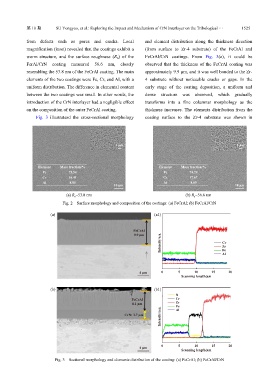
            from  defects  such  as  pores  and  cracks.  Local  and  element  distribution  along  the  thickness  direction
            magnification (inset) revealed that the coatings exhibit a  (from  surface  to  Zr-4  substrate)  of  the  FeCrAl  and

            worm  structure,  and  the  surface  roughness  (R )  of  the  FeCrAl/CrN  coatings.  From  Fig.  3(a),  it  could  be
                                                   a
            FerAl/CrN  coating  measured  56.6  nm,  closely   observed  that  the  thickness  of  the  FeCrAl  coating  was
            resembling the 53.8 nm of the FeCrAl coating. The main  approximately 9.9 µm, and it was well bonded to the Zr-
            elements of the two coatings were Fe, Cr, and Al, with a  4  substrate  without  noticeable  cracks  or  gaps.  In  the
            uniform distribution. The difference in elemental content  early  stage  of  the  coating  deposition,  a  uniform  and
            between the two coatings was small. In other words, the  dense  structure  was  observed,  which  gradually
            introduction of the CrN interlayer had a negligible effect  transforms  into  a  fine  columnar  morphology  as  the
            on the composition of the outer FeCrAl coating.    thickness increases. The elements distribution from the
                Fig.  3  illustratesd  the  cross-sectional  morphology  coating  surface  to  the  Zr-4  substrate  was  shown  in


                                                  1 μm                                                1 μm


                 Element   Mass fraction/%                           Element  Mass fraction/%
                   Fe         75.54                                    Fe         74.24
                   Cr         16.41                                    Cr         17.67
                   Al          8.05                                    Al         8.09
                                                  10 μm                                              10 μm
                             (a) R a =53.8 nm                                   (b) R a =56.6 nm

                            Fig. 2    Surface morphology and composition of the coatings: (a) FeCrAl; (b) FeCrAl/CrN

                       (a)                                         (a1)


                                                          FeCrAl
                                                          9.9 μm
                                                                     Intensity/a.u.             Cr
                                                                                                Zr
                                                                                                Fe
                                                                                                Al


                                                            4 μm      0      5      10     15      20
                                                                              Scanning length/μm

                       (b)                                         (b1)
                                                                            N
                                                         FeCrAl             Cr
                                                         8.1 μm             Zr
                                                                            Fe
                                                                     Intensity/a.u.
                                                      CrN: 3.7 μm           Al


                                                                      0      5      10     15      20
                                                            4 μm
                                                                              Scanning length/μm
                        Fig. 3    Sectional morphology and elements distribution of the coating: (a) FeCrAl; (b) FeCrAl/CrN

