


Page 130 - 摩擦学学报2025年第10期
P. 130
第 10 期       SU Yongyao, et al.: Exploring the Impact and Mechanism of CrN Interlayer on the Tribological ···  1527

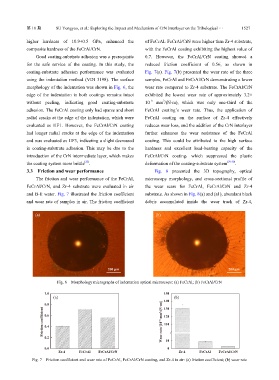
            higher  hardness  of  10.9±0.5  GPa,  enhanced  the  of FeCrAl,FeCrAl/CrN were higher than Zr-4 substrate,
            composite hardness of the FeCrAl/CrN.              with the FeCrAl coating exhibiting the highest value of

                Good coating-substrate adhesion was a prerequisite  0.7.  However,  the  FeCrAl/CrN  coating  showed  a
            for  the  safe  service  of  the  coating.  In  this  study,  the  reduced  friction  coefficient  of  0.56,  as  shown  in
            coating-substrate  adhesion  performance  was  evaluated  Fig. 7(a). Fig. 7(b) presented the wear rate of the three
            using  the  indentation  method  (VDI  3198).  The  surface  samples, FeCrAl and FeCrAl/CrN demonstrating a lower
            morphology of the indentation was shown in Fig. 6, the  wear rate compared to Zr-4 substrate. The FeCrAl/CrN
            edge of the indentation in both coatings remains intact  exhibited  the  lowest  wear  rate  of  approximately  3.2×
                                                                       3
                                                                 −6
            without  peeling,  indicating  good  coating-substrate  10   mm /(N·m),  which  was  only  one-third  of  the
            adhesion. The FeCrAl coating only had sparse and short  FeCrAl  coating’s  wear  rate.  Thus,  the  application  of
            radial cracks at the edge of the indentation, which were  FeCrAl  coating  on  the  surface  of  Zr-4  effectively
            evaluated  as  HF1.  However,  the  FeCrAl/CrN  coating  reduces wear loss, and the addition of the CrN interlayer
            had  longer  radial  cracks  at  the  edge  of  the  indentation  further  enhances  the  wear  resistance  of  the  FeCrAl
            and was evaluated as HF3, indicating a slight decreased  coating.  This  could  be  attributed  to  the  high  surface
            in  coating-substrate  adhesion.  This  may  be  due  to  the  hardness  and  excellent  load-bearing  capacity  of  the
            introduction of the CrN intermediate layer, which makes  FeCrAl/CrN  coating, which  suppressed  the  plastic
                                     [22]                                                         [29-30]
            the coating system more brittle .                  deformation of the coating-substrate system  .
             3.3    Friction and wear performance                  Fig.  8  presented  the  3D  topography,  optical
                The friction and wear performance of the FeCrAl,  microscopy  morphology,  and  cross-sectional  profile  of
            FeCrAl/CrN,  and  Zr-4  substrate  were  evaluated  in  air  the  wear  scars  for  FeCrAl,  FeCrAl/CrN  and  Zr-4
            and B-Ii water. Fig. 7 illustrated the friction coefficient  substrate. As shown in Fig. 8(a) and (a1), abundant black
            and wear rate of samples in air. The friction coefficient  debris  accumulated  inside  the  wear  track  of  Zr-4,


                (a)                                                (b)


                                               200 μm                                              200 μm

                         Fig. 6    Morphology micrographs of indentation optical microscope: (a) FeCrAl; (b) FeCrAl/CrN

                    1.0                                                150

                        (a)                                                (b)
                    0.8                                                140
                                                                       130
                   Friction coeffiicient  0.6                         Wear rate/[10 −6  mm 3 /(N·m)]  120


                                                                       110
                    0.4
                    0.2

                    0.0                                                 10 0
                          Zr-4     FeCrAl  FeCrAl/CrN                        Zr-4     FeCrAl  FeCrAl/CrN
               Fig. 7    Friction coefficient and wear rate of FeCrAl, FeCrAl/CrN coating, and Zr-4 in air: (a) friction coefficient; (b) wear rate

