


Page 132 - 摩擦学学报2025年第10期
P. 132
第 10 期       SU Yongyao, et al.: Exploring the Impact and Mechanism of CrN Interlayer on the Tribological ···  1529


               (a)

                                                                      O                   ZrO 2
                                      200 μm
                                               Intensity/a.u.         Zr      Intensity/a.u.

                    A                 B                                               ZrO 2
                        Scanning direction


                                   500 μm      0    100  200  300   400  500  0    200  400  600  800  1 000
                                                         Distance/μm                  Raman shift/cm −1

               (b)                              Edge             Edge

                                                                                          Fe 2 O 3
                                                                      Fe
                                       40 μm
                                               Intensity/a.u.         Cr      Intensity/a.u.  Cr 2 O 3

                       C          D                                   Al
                       Scanning direction
                                                                      O
                                   500 μm      0    50   100  150   200  250  0    200  400  600  800  1 000
                                                         Distance/μm                  Raman shift/cm −1
               (c)
                                                Edge            Edge
                                                                                           Fe 2 O 3
                                                                      Fe
                                       40 μm
                                               Intensity/a.u.         Cr      Intensity/a.u.  Cr 2 O 3

                         E      F                                     Al
                       Scanning direction
                                                                      O
                                   500 μm      0    40   80   120   160  200  0    200  400  600  800  1 000
                                                         Distance/μm                  Raman shift/cm −1

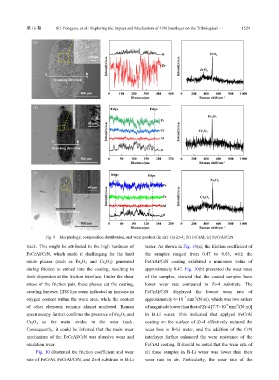
                    Fig. 9    Morphology, composition distribution, and wear product (in air): (a) Zr-4; (b) FeCrAl; (c) FeCrAl/CrN
            track.  This  might  be  attributed  to  the  high  hardness  of  water. As shown in Fig. 10(a), the friction coefficient of
            FeCrAl/CrN,  which  made  it  challenging  for  the  hard  the  samples  ranged  from  0.47  to  0.63,  with  the
            oxide  phases  (such  as  Fe O   and  Cr O )  generated  FeCrAl/CrN  coating  exhibited  a  minimum  value  of
                                              2
                                                3
                                     3
                                   2
            during  friction  to  embed  into  the  coating,  resulting  in  approximately 0.47. Fig. 10(b) presented the wear rates
            their dispersion at the friction interface. Under the shear  of  the  samples,  showed  that  the  coated  samples  have
            stress of the friction pair, these phases cut the coating,  lower  wear  rate  compared  to  Zr-4  substrate.  The
            creating furrows. EDS line scans indicated an increase in  FeCrAl/CrN  displayed  the  lowest  wear  rate  of
                                                                                    3
                                                                               −7
            oxygen content within the worn area, while the content  approximately 6×10  mm /(N·m), which was two orders
                                                                                                      3
                                                                                                 −5
            of  other  elements  remains  almost  unaltered.  Raman  of magnitude lower than that of Zr-4 [7.7×10  mm /(N·m)]
            spectroscopy further confirms the presence of Fe O  and  in  B-Li  water.  This  indicated  that  applyed  FeCrAl
                                                      3
                                                    2
            Cr O   as  the  main  oxides  in  the  wear  track.  coating  on  the  surface  of  Zr-4  effectively  reduced  the
              2
                 3
            Consequently,  it  could  be  inferred  that  the  main  wear  wear  loss  in  B-Li  water,  and  the  addition  of  the  CrN
            mechanism  of  the  FeCrAl/CrN  was  abrasive  wear  and  interlayer  further  enhanced  the  wear  resistance  of  the
            oxidation wear.                                    FeCrAl coating. It should be noted that the wear rate of
                Fig. 10 illustrated the friction coefficient and wear  all  three  samples  in  B-Li  water  was  lower  than  their
            rate of FeCrAl, FeCrAl/CrN, and Zr-4 substrate in B-Li  wear  rate  in  air.  Particularly,  the  wear  rate  of  the

