


Page 134 - 摩擦学学报2025年第10期
P. 134
第 10 期       SU Yongyao, et al.: Exploring the Impact and Mechanism of CrN Interlayer on the Tribological ···  1531


               (a)                              Edge               Edge

                                                                                          ZrO 2
                                      30 μm                           Zr
                                               Intensity/a.u.                 Intensity/a.u.

                     E              F                                                 ZrO 2
                       Scanning direction
                                                                      O

                                    400 μm     0      100     200    300      0    200  400  600  800  1 000
                                                         Distance/mm                  Raman shift/cm −1

               (b)                               Edge               Edge
                                                                        Fe
                                                                                          Fe 2 O 3
                                      30 μm
                                               Intensity/a.u.           Cr    Intensity/a.u.

                     C              D                                   Al
                       Scanning direction                               O

                                    100 μm     0    20    40   60    80  100  0    200  400  600  800  1 000
                                                         Distance/μm                  Raman shift/cm −1

               (c)                                 Edge         Edge
                                                                                          Fe 2 O 3
                                      30 μm                            Fe
                                               Intensity/a.u.                 Intensity/a.u.  Cr 2 O 3 ·nH 2 O


                     A              B                                  Cr
                                                                       Al
                       Scanning direction
                                                                       O
                                    100 μm     0     25    50    75    100    0    200  400  600  800  1 000
                                                         Distance/μm                  Raman shift/cm −1

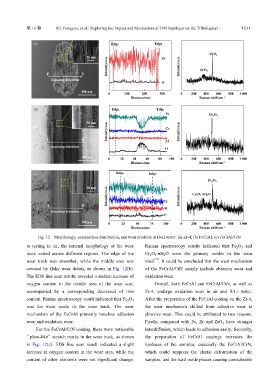
                 Fig. 12    Morphology, composition distribution, and wear products in B-Li water: (a) Zr-4; (b) FeCrAl; (c) FeCrAl/CrN
            to  testing  in  air,  the  internal  morphology  of  the  wear  Raman  spectroscopy  results  indicated  that  Fe O   and
                                                                                                        3
                                                                                                      2
            track  varied  across  different  regions.  The  edge  of  the  Cr O ·nH O  were  the  primary  oxides  in  the  wear
                                                                 2
                                                                   3
                                                                       2
                                                                   [34]
            wear  track  was  smoother,  while  the  middle  area  was  track . It could be concluded that the wear mechanism
            covered  by  flaky  wear  debris,  as  shown  in  Fig.  12(b).  of  the  FeCrAl/CrN  mainly  include  abrasion  wear  and
            The EDS line scan results revealed a sudden increase of  oxidation wear.
            oxygen  content  in  the  middle  area  of  the  wear  scar,  Overall, both FeCrAl and FeCrAl/CrN, as well as
            accompanied  by  a  corresponding  decreased  of  iron  Zr-4,  undergo  oxidation  wear  in  air  and  B-Li  water.
            content. Raman spectroscopy result indicated that Fe O 3  After the preparation of the FeCrAl coating on the Zr-4,
                                                       2
            was  the  main  oxide  in  the  wear  track.  The  wear  the  wear  mechanism  shifted  from  adhesive  wear  to
            mechanism  of  the  FeCrAl  primarily  involves  adhesion  abrasive wear. This could be attributed to two reasons.
            wear and oxidation wear.                           Firstly,  compared  with  Fe,  Zr  and  ZrO   have  stronger
                                                                                                2
                For the FeCrAl/CrN coating, there were noticeable  interdiffusion, which leads to adhesion easily. Secondly,
            “plow-like” scratch marks in the wear track, as shown  the  preparation  of  FeCrAl  coatings  increases  the
            in  Fig.  12(c).  EDS  line  scan  result  indicated  a  slight  hardness  of  the  samples,  especially  the  FeCrAl/CrN,
            increase  in  oxygen  content  in  the  wear  area,  while  the  which  could  suppress  the  elastic  deformation  of  the
            content  of  other  elements  were  not  significant  change.  samples, and the hard oxide phases causing considerable

