


Page 129 - 摩擦学学报2025年第10期
P. 129
1526                                   摩擦学学报(中英文)                                        第 45 卷


            Fig.  3(a1).  In  the  coating  region,  the  elements  Fe,  Cr,              CrN
                                                                                          FeCrAl
            and  Al  were  uniformly  distributed  without  significant                   FeCrAl/CrN
                                                                                Fe(110)
            fluctuations or segregation. After the addition of the CrN                         Fe(211)
                                                                       Intensity/a.u.
            interlayer, the thickness of the FeCrAl and CrN coating                      Fe(200)
            were approximately 8.1 µm and 3.7 µm, respectively. It
            was also well bonded to the Zr-4 substrate. The cross-
            section  of  the  FeCrAl/CrN  coating  still  exhibited  a
            columnar  crystalline  structure  [Fig.  3(b)],  but  the
                                                                           30    45     60    75    90
            columns appear thicker compared to the FeCrAl coating.                   2θ/(°)
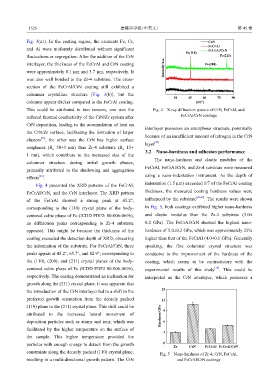
            This  could  be  attributed  to  two  reasons,  one  was  the  Fig. 4    X-ray diffraction spectra of CrN, FeCrAl, and
            reduced thermal conductivity of the CrN/Zr system after           FeCrAl/CrN coatings
            CrN deposition, leading to the accumulation of heat on
                                                               interlayer possesses an amorphous structure, potentially
            the  CrN/Zr  surface,  facilitating  the  formation  of  larger
                                                               because of an insufficient amount of nitrogen in the CrN
                  [23]
            clusters ,  the  other  was  the  CrN  has  higher  surface
                                                                   [25]
                                                               layer .
            roughness  (R =58±3  nm)  than  Zr-4  substrate  (R =15±
                       a
                                                     a
                                                                3.2    Nano-hardness and adhesion performance
            1  nm),  which  contribute  to  the  increased  size  of  the
                                                                   The  nano-hardness  and  elastic  modulus  of  the
            columnar  structure  during  initial  growth  phases,
                                                               FeCrAl, FeCrAl/CrN, and Zr-4 substrate were measured
            primarily  attributed  to  the  shadowing  and  aggregation
                  [24]
            effects .                                          using  a  nano-indentation  instrument.  As  the  depth  of
                                                               indentation (1.5 µm) exceeded 1/7 of the FeCrAl coating
                Fig. 4 presented the XRD patterns of the FeCrAl,
                                                               thickness,  the  measured  coating  hardness  values  were
            FeCrAl/CrN, and the CrN interlayer. The XRD pattern
            of  the  FeCrAl  showed  a  strong  peak  at  45.2°,  influenced by the substrate [26-27] . The results were shown
            corresponding  to  the  (110)  crystal  plane  of  the  body-  in Fig. 5, both coatings exhibited higher nano-hardness
            centered cubic phase of Fe (ICDD PDF2: 00-006-0696),  and  elastic  modulus  than  the  Zr-4  substrate  (3.0±
            no  diffraction  peaks  corresponding  to  Zr-4  substrate  0.2  GPa).  The  FeCrAl/CrN  showed  the  highest  nano-
            appeared.  This  might  be  because  the  thickness  of  the  hardness of 5.0±0.2 GPa, which was approximately 25%
            coating exceeded the detection depth of XRD, obscuring  higher than that of the FeCrAl (4.0±0.1 GPa). Generally
            the information of the substrate. For FeCrAl/CrN, three  speaking,  the  fine  columnar  crystal  structure  was
            peaks appear at 45.2°, 65.7°, and 82.9°, corresponding to  conducive  to  the  improvement  of  the  hardness  of  the
            the  (110),  (200),  and  (211)  crystal  planes  of  the  body-  coating,  which  seems  to  be  contradictory  with  the
            centered cubic phase of Fe (ICDD PDF2 00-006-0696),  experimental  results  of  this  study .  This  could  be
                                                                                             [28]
            respectively. The coating demonstrated an inclination for  interpreted  as  the  CrN  interlayer,  which  possesses  a
            growth along the (211) crystal plane. It was apparent that
                                                                      15

            the introduction of the CrN interlayer led to a shift in the
            preferred  growth  orientation  from  the  densely  packed  12
                                                                      Hardness/GPa
            (110) plane to the (211) crystal plane. This shift could be  9
            attributed  to  the  increased  lateral  movement  of
            deposition particles such as atoms and ions, which was     6
            facilitated  by  the  higher  temperature  on  the  surface  of
                                                                       3
            the  sample.  This  higher  temperature  provided  the
                                                                       0
            particles with enough energy to detach from the growth         Zr     CrN    FeCrAl FeCrAl/CrN
            constraints along the densely packed (110) crystal plane,
                                                                     Fig. 5    Nano-hardness of Zr-4, CrN, FeCrAl,
            resulting in a multi-directional growth pattern. The CrN         and FeCrAl/CrN coatings

