


Page 126 - 摩擦学学报2025年第10期
P. 126
第 10 期       SU Yongyao, et al.: Exploring the Impact and Mechanism of CrN Interlayer on the Tribological ···  1523

            influence  on  the  frictional  properties.  However,  while  nuclear reactors, preparing CrN on Zirconium alloy can
            existing  literatures  predominantly  delve  into  the  effectively  suppress  Zr  outward  diffusion.  It  can  be
            oxidation and corrosion resistance properties of FeCrAl  predicted that by introducing CrN layers between Zr and
            coating,  there  remains  a  dearth  of  research  concerning  FeCrAl  coating  can  effectively  suppress  Zr  diffusion
            their  wear  resistance  properties,  leaving  the  wear  towards  FeCrAl  coating,  simultaneously  enhancing  the
            mechanism poorly understood. Hence, it is necessary to  load-bearing  capacity  of  the  Zirconium  alloy,  thus
            conduct in-depth investigations into the wear mechanism  beneficial for obtaining excellent wear resistance as well
            of  FeCrAl  coatings,  which  is  crucial  for  the  safe  as oxidation resistance in nuclear fuel cladding coatings.
            operation  of  FeCrAl  coatings  in  pressurized  water  In this study, magnetron sputtering technology was
            reactors.                                          utilized to deposit an FeCrAl coating on the surface of
                Transition  metal  nitrides,  such  as  TiN,  CrN,  and  the  Zr-4  substrate,  aiming  to  investigate  the  frictional
            TiAlN  offer  a  plethora  of  advantages,  including  mechanism  of  FeCrAl  coating.  To  enhance  the  load-
            exceptional hardness, superb wear resistance, and robust  bearing capacity of Zr-4 substrate and further improved
            high-temperature  tolerance,  rendering  them  indispen-  the tribological property of FeCrAl coating, a CrN layer
            sable for enhancing the surfaces of cutting tools, molds,  was introduced between them. A comparative analysis of
                                [17]                           the mechanical properties and wear resistance of the two
            and  critical  components .  Among  them,  CrN  exhibits
                                                               types  of  coatings  was  conducted  in  both  air  and  B-Li
            outstanding  oxidation  resistance  and  mechanical
                                                               water.  The  friction  coefficient,  wear  rate,  wear
            properties, holding promise for application in coating the
            surface of nuclear fuel cladding material. Daub et al [18]  morphology,  and  debris  were  extensively  examined  to
                                                               gain  insight  into  the  wear  mechanism  of  the  coatings
            investigated  the  short-term  corrosion  performance  of
                                                               under air and B-Li water conditions. The results would
            CrN  in  high-temperature  steam  and  found  that  CrN
            coating  has  good  corrosion  resistance.  Lee  et  al [19]  provided a theoretical foundation and technical guidance
                                                               for a deeper understanding of the tribological properties
            revealed that CrN decomposes at 950 ℃, with the main
                                                               of  FeCrAl-based  coatings,  which  was  of  significant
                                             [20]
            oxidation product being Cr O . Liu et al  revealed that
                                  2
                                    3
                                                               importance for the safe service of nuclear fuel cladding
            CrN can inhibit the outward diffusion of Zr and prevent
                                                               materials.
            the formation of low-melting Zr-Cr eutectic when it was
            deposited on zirconium alloy, and decomposes to form
                                                                2    Materials and methods
            Cr N in 1 000 ℃ steam while still providing a certain
              2
            protective effect. In summary, the oxidation resistance of   2.1    Coating preparation
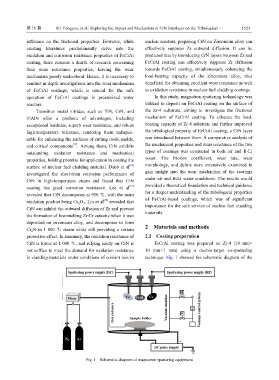
            CrN is lower at 1 000 ℃, and relying solely on CrN is  FeCrAl  coating  was  prepared  on  Zr-4  (10  mm×
            not suffice to meet the demand for oxidation resistance  10  mm×1  mm)  using  a  double-target  co-sputtering
            in cladding materials under conditions of coolant loss in  technique. Fig. 1 showed the schematic diagram of the

                              Sputtering power supply (DC)              Sputtering power supply (RF)


                                                                              M
                              Mixer                    Fe  CrAl  Cr
                                                 Gas entrance  Sample holder  Vacuum chamber  M  Vacuum control system


                                  Ar
                             N 2
                                                                   DC pulse supply

                                      Fig. 1    Schematic diagram of magnetron sputtering equipment

