


Page 127 - 摩擦学学报2025年第10期
P. 127
1524                                   摩擦学学报(中英文)                                        第 45 卷

            magnetron  sputtering  device.  The  device  consists  of  a  argon gas (mass fraction 99.999%) was introduced into
            vacuum  chamber,  a  vacuum  pump  set,  and  an  electric  the chamber, and a bias voltage (DC, 450 V) was applied
            control  system.  The  sample  holder  was  located  at  the  to the substrate. The samples were sputter-cleaned in the
            bottom of the chamber, and a direct current (DC) pulse  argon plasma. Then the CrN inter-layer was prepared by
            power was applied to the sample holder. The sputtering  sputtering  Cr  target  (99.99%)  in  argon  and  nitrogen
            target was fixed at the top of the vacuum chamber, and  mixture  gas.  FeCrAl  coatings  were  deposited  on  CrN
            the distance between the target and the sample was set to  layer  by  simultaneously  sputtering  the  Fe  and  CrAl
            8  cm.  Radio  frequency  (RF,  13.56  MHz)  power  was  target  (Cr:Al=65:35%)  at  500  ℃.  For  comparison,  a
            used  for  sputtering  the  Cr  target  (99.99%),  and  DC  FeCrAl coating was directly deposited onto Zr. FeCrAl
            power was used for sputtering the Fe and CrAl targets.  coatings  with  and  without  CrN  layer  were  labeled  as
            Using  a  vacuum  pump  set  created  a  high  vacuum  FeCrAl/CrN  and  FeCrAl,  respectively.  Further  details
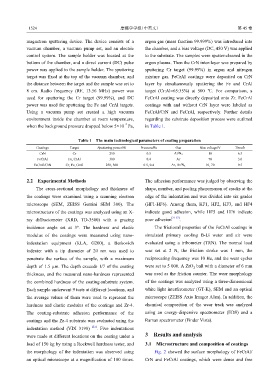
            environment  inside  the  chamber  at  room  temperature,  regarding the substrate deposition process were outlined
                                                      −4
            when the background pressure dropped below 5×10  Pa,  in Table 1.


                                  Table 1    The main technological parameters of coating preparation
                 Coatings      Target      Sputtering power/W  Pressure/Pa  Gas       Bias voltage/V  Time/h
                  CrN           Cr              250             0.5        Ar/N 2         10           6.5
                 FeCrAl       Fe, CrAl          300             0.4         Ar            70           3.0
               FeCrAl/CrN    Cr, Fe, CrAl     250, 300        0.5, 0.4    Ar, Ar/N 2     10, 70        9.5


             2.2    Experimental Methods                       The adhesion performance was judged by observing the
                The  cross-sectional  morphology  and  thickness  of  shape, number, and peeling phenomenon of cracks at the
            the  coatings  were  examined  using  a  scanning  electron  edge of the indentation and was divided into six grades
            microscope  (SEM,  ZEISS  Gemini  SEM  300).  The  (HF1-HF6).  Among  them,  HF1,  HF2,  HF3,  and  HF4
            microstructure of the coatings was analyzed using an X-  indicate  good  adhesion,  while  HF5  and  HF6  indicate
            ray  diffractometer  (XRD,  TD-3500)  with  a  grazing  poor adhesion [21-22] .
            incidence  angle  set  at  3°.  The  hardness  and  elastic  The frictional properties of the FeCrAl coatings in
            modulus  of  the  coatings  were  measured  using  nano-  simulated  primary  cooling  B-Li  water  and  air  were
            indentation  equipment  (KLA,  G200),  a  Berkovich  evaluated  using  a  tribometer  (TRN).  The  normal  load
            indenter  with  a  tip  diameter  of  20  nm  was  used  to  was  set  at  2  N,  the  friction  stroke  was  1  mm,  the
            penetrate  the  surface  of  the  sample,  with  a  maximum  reciprocating frequency was 10 Hz, and the wear cycles
            depth of 1.5 µm. The depth exceeds 1/7 of the coating  were set to 5 000. A ZrO  ball with a diameter of 6 mm
                                                                                    2
            thickness,  and  the  measured  nano-hardness  represented  was used as the friction counter. The wear morphology
            the combined hardness of the coating-substrate system.  of the coatings was analyzed using a three-dimensional
            Each sample underwent 9 tests at different locations, and  white light interferometer (GT-K), SEM and an optical
            the  average  values  of  them  were  used  to  represent  the  microscope (ZEISS Axio Imager A1m). In addition, the

            hardness and elastic modulus of the coatings and Zr-4.  chemical  composition  of  the  wear  track  was  analyzed
            The  coating-substrate  adhesion  performance  of  the  using  an  energy-dispersive  spectrometer  (EDS)  and  a
            coatings and the Zr-4 substrate was evaluated using the  Raman spectrometer (Finder Vista).
            indentation  method  (VDI  3198)   [21] .  Five  indentations
            were made at different locations on the coating under a   3    Results and analysis
            load of 150 kg by using a Rockwell hardness tester, and   3.1    Microstructure and composition of coatings
            the  morphology  of  the  indentation  was  observed  using  Fig. 2 showed the surface morphology of FeCrAl/
            an optical microscope at a magnification of 100 times.  CrN  and  FeCrAl  coatings,  which  were  dense  and  free

