


Page 136 - 《爆炸与冲击》2026年第9期
P. 136
第 46 卷                  陈柏翰,等: 侵彻弹体的拉压模态与振动特性                                   第 9 期

                                     1st mode                2nd mode                 3rd mode

                   Projectile Ⅰ

                   Projectile Ⅱ

                                                      0  0.2  0.4  0.6  0.8  1.0
                                                   |Δu|

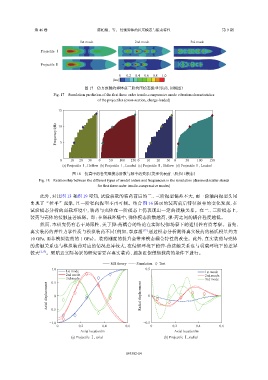
                                       图 17    仿真预测的弹体前三阶拉压模态振型(装药,剖视图)
                         Fig. 17    Simulation prediction of the first three order tensile-compressive mode vibration characteristics
                                            of the projectiles (cross-section, charge-loaded)

                           15


                          Frequency/kHz  10 5


                            0   10  20  30   0   50   100  150 0  10   20  30  0   50    100  150
                             (a) Projectile Ⅰ, Hollow (b) Projectile Ⅰ, Loaded (c) Projectile Ⅱ, Hollow (d) Projectile Ⅱ, Loaded

                                 图 18    仿真中的各类型模态阶数与频率的关系(菱形代表前三阶拉压模态)
                  Fig. 18    Relationship between the different types of modal orders and frequencies in the simulation (diamond scatter stands
                                            for first three order tensile-compressive modes)

                   此外,对比图      13  和图  19  可知,试验获取的装药前后的二、三阶振型偏差不大,而一阶轴向振型头尾
               出现了“拉平”现象,且一阶径向振型不再可测。结合图                           16  展示的装药前后特征频率的变化发现,在
               试验模态分析的弱载环境中,装药与壳体在一阶模态上仍表现出一定的接触关系。在二、三阶模态上,
               装药与壳体的接触显著减弱。即:在弱载环境中,弹体模态阶数越高,弹-药之间的耦合程度越低。
                   然而,本研究仍有若干局限性,关于弹-药耦合的结论在实际侵彻场景下的适用性有待考察。首先,
               真实装药的弹性力学性质与模拟装药不同(例如,李彦超                        [17]  通过模态分析测得真实装药的杨氏模量约为
               10 GPa,而非模拟装药的        1 GPa)。装药刚度的提升会带来模态耦合特性的改变。此外,真实装药与壳体
               的接触关系也与模拟装药对应的情况差异较大,在侵彻环境下的弹-药接触关系也与弱载环境下的差异
               较大  [2,17] 。更贴近实际场景的研究需要在真实装药、施加近似侵彻载荷的条件下进行。


                                                  MH theory   Simulation  Test
                        1.0   1st mode                            0.5                       1st mode
                              2nd mode                                                      2nd mode
                              3rd mode                                                      3rd mode
                        0.5
                      Axial displacement  −0.5 0                Radial displacement  0


                       −1.0                                      −0.5
                          0         0.2       0.4        0.6        0         0.2       0.4       0.6
                                     Axial location/m                         Axial location/m
                                 (a) Projectile Ⅰ, axial                  (b) Projectile Ⅰ, radial
                        1.0                                       0.4
                                                                                            1st mode
                                                                                            2nd mode
                        0.5                              093302-14  0.2

                         0                                         0


                       −0.5                                      −0.2
                                        1st mode
                                        2nd mode
                       −1.0                                      −0.4
                          0         0.2       0.4        0.6        0         0.2       0.4       0.6

                                         Ⅱ                                         Ⅱ

