


Page 171 - 《爆炸与冲击》2026年第8期
P. 171
第 46 卷         李洪超,等: 基于蒙特卡罗方法的孔间延时对爆破振动波叠加效应的影响                                第 8 期

               model  was  constructed  that  can  reflect  the  nonlinear  vibration  relationship  between  holes.  Using  a  copper  mine  in  Jiangxi
               Province  as  the  engineering  context,  the  constrained-traversal  algorithm  was  employed  to  optimize  the  parameters  of  the
               single-hole prediction model. The simulated waveform output by this model exhibits a peak velocity error of 0.7% compared
               to the measured single-hole waveform, with identical predictions for the dominant frequency. The peak velocity error between
               the simulated waveform output by the group-hole blast vibration prediction model and the measured group-hole waveform is
               3.9%, with the dominant frequency prediction being completely consistent. This fully validates the effectiveness of both the
               single-hole and group-hole blast vibration prediction models. Based on dual-hole blasting vibration experiments, employing
               Monte Carlo methodology, the model generated 1 000 sets of single-hole simulated waveforms. From these, 500 sets of dual-
               hole blasting vibration waveform characteristics (peak velocity, dominant frequency, and energy distribution across frequency
               bands) were extracted to construct a sample set. Subsequently, statistical analysis was conducted on the damping rate, dominant
               frequency, and energy distribution across frequency bands for the superimposed vibration waves of dual-hole blasts at different
               delay  times  and  blast  center  distances,  using  the  upper  limit  of  the  95%  confidence  interval  and  the  mean  value.  Results
               indicate that at the same blast center distance, as the delay time increases, the damping rate first increases and then stabilizes.
               At the same time the dominant frequency gradually decreases, with high-frequency energy progressively shifting toward low-
               frequency energy. At different blast centers, as the blast center distance increases, the damping rate generally decreases across
               various delay times. The dominant frequency shifts toward lower frequencies, resulting in an overall increase in low-frequency
               energy  and  an  overall  decrease  in  high-frequency  energy.  The  Monte  Carlo  method,  based  on  extensive  simulations  and
               statistical  analysis,  not  only  reveals  the  random  characteristics  of  blasting  vibration  signals,  but  also  enables  quantitative
               analysis of their time-domain and frequency-domain features, holding significant theoretical and engineering value.
               Keywords:  randomness of blasting vibrations; blasting vibration prediction model; Monte Carlo method; analysis of blasting
               vibration characteristics
                   钻孔爆破是一种广泛应用于露天矿山、基坑开挖和地下矿山等基础建设领域的工程技术手段。然而,
                                                                                                     [1]
               在爆炸过程中用于破碎岩石的能量仅占                 20%~30%,剩余的能量以碎石飞掷、振动及噪声等形式扩散 。在
               爆破所带来的副作用中振动所造成的安全危害最大,已成为爆破工程中必须考虑的问题                                       [2-3] 。但随着技术
               的发展,工业电子雷管的出现,使得毫秒爆破技术成为提高爆破效率和降低振动危害的最有效方法之一,通
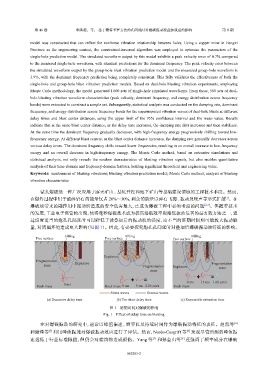
               过设置适当的炮孔孔间延时可以降低子波叠加后的振动波的强度,而不当的延期时间则可能放大振动能
               量,对周围环境造成更大影响(见图              1)。因此,有必要探究炮孔孔间延时对叠加后爆破振动波特征的影响。


                              Filling                    Filling                      Filling
                 Free surface                   Free surface                  Free surface


                                               Explosive
                 Fragmentation
                    zone          Explosive                     Fragmentation   Explosive      Fragmentation
                                                                                                  zone
                                                                    zone

                                                                                    0 ms  15 ms 1.68 cm/s
                             0 ms
                 Rock mass                      Rock mass  0 ms  5 ms 2.26 cm/s  Rock mass
                                                  Stress waves    Seismic waves
                      (a) Excessive delay time       (b) Too short delay time    (c) Reasonable extension time
                                                  图 1    延期时间对爆破的影响
                                               Fig. 1    Effect of delay time on blasting
                   在对爆破振动的研究中,通常以峰值振速、频率以及持续时间作为爆破振动特征的表征。赵凯等                                            [4]
                                                                                    [6]
               和谢烽等 利用峰值振速对爆破振动效应进行了评估。然而,Norén-Cosgriff 等 发现尽管所测的峰值振
                       [5]
               速远低于行业标准限值,但仍会对建筑物造成损伤。Yang                         等 [7]  和孙金山等  [8]  还强调了频率成分在爆破


                                                         085203-2

