


Page 92 - 《爆炸与冲击》2026年第4期
P. 92
第 46 卷         刘晏东,等: 超高速撞击玄武岩材料的Riemann-SPH仿真参数分析与验证                           第 4 期


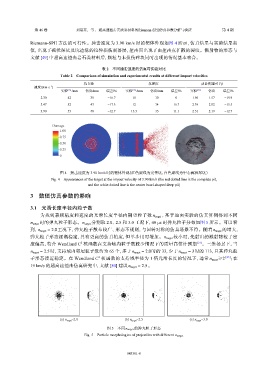
               Riemann-SPH  方法的可行性。撞击速度为             3.90 km/s 时的靶体外观如图        4  所示,仿真结果与实验结果类
               似,出现了碗状深坑及坑边缘的拉伸损伤剥落层,撞击面出现了由撞击点扩散的裂纹。溅射物的形态与
               文献  [49] 中超高速撞击岩石类材料后,颗粒与未损伤碎块同时出现的情况基本吻合。


                                              表 2    不同撞击速度的仿真与实验对比
                            Table 2    Comparison of simulation and experimental results at different impact velocities
                                      坑直径                          坑深度                    动量传递因子β
                       −1
                速度/(km·s )
                            实验 [15]  /mm  仿真/mm  误差/%    实验 [15]  /mm  仿真/mm  误差/%   实验 [15]  仿真    误差/%
                   2.30        42        35      −16.7      10        10       0      1.96    1.57   −19.9
                   3.47        52        43      −17.3      12        14      16.7    2.39    2.02   −15.5
                   3.90        55        48      −12.7     13.5       15      11.1    2.51    2.19   −12.7


                        Damage
                            1.00
                            0.75
                            0.50
                            0.25
                            0


                            图 4    撞击速度为  3.90 km/s 时的靶体外观(红色虚线为完整坑,白色虚线为中心碗状深坑)
                        Fig. 4    Appearances of the target at the impact velocity of 3.90 km/s (the red dotted line is the complete pit,
                                        and the white dotted line is the center bowl-shaped deep pit)
                3    数值仿真参数的影响


                3.1    光滑长度半径内粒子数
                                                                     n target  ,基于地面实验的仿真算例得到不同
                   为找到兼顾精度和速度的光滑长度半径内期望粒子数
                                      n target  分别取  2.0、2.5  和  3.0  工况下,40 μs 时弹丸粒子分布如图   5  所示。可以看
               n target  时的弹丸粒子形态。
                                                                                                n target  的增大,
               到,    n target = 2.0  工况下,弹丸粒子散布较广、形态不规则,与回转对称的仿真场景不符。随着
                                                                          n target  较小时,先射出的溅射物粒子密
               弹丸粒子形态逐渐稳定,具有更高的仿真精度,但单步用时增加。
               度偏高,符合      Wendland C 核函数在支持域内粒子数较少情况下的质量高估计预期                           [21] 。三维场景下,当
                                     2
               n target = 2.5  时,支持域内邻居粒子数约为      65  个,多于  n target = 2.0  时的  33,少于  n target = 3  时的  113,且其弹丸粒
                                             2
               子形态接近稳定。在          Wendland C 核函数的支持域半径为             1  倍光滑长度的情况下,通常           n target ≥2   [23] ;在
               19 km/s 的超高速撞击仿真研究中,文献             [50] 建议  n target = 2.5  。


                            (a) n target =2.0           (b) n target =2.5            (c) n target =3.0
                                                         n target  的弹丸粒子形态
                                                图 5    不同
                                      Fig. 5    Particle morphologies of projectiles with different   n target


                                                         043301-8

