


Page 153 - 《爆炸与冲击》2026年第2期
P. 153
第 46 卷          高    矗,等: 剪切增强和应变率效应对混凝土类材料状态方程的影响                              第 2 期


               behaviors,  including  the  shear-enhanced  compaction  effect  and  strain-rate  effect.  Based  on  the  high-fidelity  numerical
               simulations  described  above,  a  quantitative  analysis  was  conducted  to  investigate  the  influence  of  the  shear-enhanced
               compaction  effect  and  strain-rate  effect  on  EoS  behavior  of  concrete-like  materials,  and  the  challenges  associated  with
               eliminating  the  shear-enhanced  compaction  and  strain-rate  coupling  effects  in  flyer-plate  impact  tests  were  systematically
               identified. The results demonstrate that the Kong-Fang model, when combined with the SPG algorithm, can accurately simulate
               the complex dynamic mechanical behaviors of concrete-like materials, including shear-enhanced compaction effect and strain-
               rate effect. To achieve high-precision simulation of dynamic mechanical behaviors of concrete-like materials subjected to blast
               and impact loadings across high-medium-low pressure ranges, it is essential to establish an EoS with a wide-range pressure
               based on experimental data from EoS behavior tests. However, shear-enhanced compaction and strain-rate coupling effects
               should  be  eliminated  when  using  flyer-plate  impact  test  data  to  calibrate  the  EoS  parameters.  A  paradox  arises  in  the
               establishment of EoS with wide-range pressure for concrete-like materials, and the application of numerical iteration correction
               methodology may represent an effective approach to resolving this challenge. These findings provide a theoretical foundation
               for the future development of a numerical iteration correction methodology to eliminate the shear-enhanced compaction effect
               and strain-rate effect on the EoS of concrete-like materials, thereby facilitating the establishment of a high-precision EoS with a
               wide range of pressure for concrete-like materials subjected to impact and blast loadings.
               Keywords:  concrete-like material; blast and impact loadings; equation of state; shear-enhanced compaction effect; strain-rate effect

                   混凝土类材料(普通混凝土、水泥砂浆和超高性能混凝土等材料的统称)广泛用于军用和民用防护
               结构中   [1-3] 。在炸药爆炸或弹体侵彻等强动载作用下,混凝土类材料可能发生动态拉伸、剪切和压缩等典
               型破坏现象     [4-5] 。对爆炸冲击荷载作用下混凝土类材料中应力波传播衰减和动态损伤破坏的精细化数值
               模拟是当前研究的热点和难点             [6-8] 。
                   在爆炸冲击荷载作用近区,混凝土类材料因受高压和高应变率作用而呈近似流体状态,经典损伤塑
                                                    [9]
               性模型难以有效描述该状态下的力学行为 。目前普遍采用的爆炸冲击荷载作用下混凝土类材料模型
               为流体弹塑性模型,如          Holmquist-Johnson-Cook (HJC)模型   [10] 、Riedel-Hiermaier-Thoma (RHT)模型  [11] 、
               Karagozian and Case (K&C)模型 [12]  和  Kong-Fang  模型  [13] 。在流体弹塑性模型中,混凝土类材料因孔隙坍
               塌和裂纹扩展引起的力学行为变化分别由状态方程(球量)和强度面(偏量)描述。在爆炸冲击荷载作用
               下,动态压缩破坏发生在高静水压力状态,动态剪切破坏发生在较低或中等静水压力状态,而动态拉伸
               破坏则通常发生在低静水压力状态 。因此,流体弹塑性模型中的状态方程必须能同时准确描述混凝土
                                              [4]
               类材料在高-中-低压下的力学行为,即需要建立混凝土类材料宽广压力范围的状态方程。然而,由于混
               凝土类材料的等压屈服特性和剪胀特性                  [13-14] ,材料既可在等压受力下因压缩而屈服,也可在剪应力作用
               下产生体积变形,体积应变与剪应力有关,剪应变与静水压力有关,即存在应力球量与偏量的耦合作用                                           [13-16] ,
               从而给建立混凝土类材料高精度、宽广压力范围的状态方程带来很大挑战。

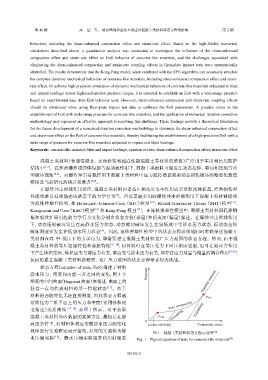
                   状态方程(equation of state,EoS)描述了材料
               静水压力、密度和内能三者之间的变化,用                    3  个        Pressure
               维度的空间曲面(Hugoniot 曲面)来描述,曲面上的                                                Granular material
               任意一点均代表材料的某一特定状态                  [15] 。由于
               材料的内能变化无法直接测量,因此状态方程通                                                        p lock
               常简化为二维平面上的压力和密度(常用体积应                                        Pore compaction
               变描述)关系曲线         [17-18] ,如图  1  所示。对于获取                                 Unloading
               混凝土类材料      EoS  数据的实验方法,最初是在静                          p crush  Unloading
                                                                 O
               高压条件下,对材料体积应变随静水压力的变化                               Linear elasticity     Volumetric strain
               规律进行实验研究而开始的,对应的实验称为静
                                                                     图 1    混凝土类材料状态方程示意图       [18]
               水压缩实验     [19] 。静水压缩实验通常利用伺服装                  Fig. 1    Typical equation of state for concrete-like materials [18]


                                                         023105-2

