


Page 198 - 《振动工程学报》2026年第2期
P. 198
514                                振     动     工     程     学     报                     第 39 卷

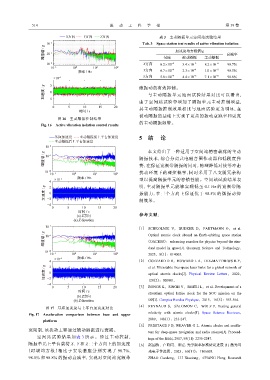
                               X方向     Y方向     Z方向                Tab. 3 Space station test results of active vibration isolation

                                                                         表 3 主动隔振单元空间站试验结果
                        −5
                     幅值谱 / g 10 −7                                         基座    加速度均方根值/g    主动隔振      衰减率
                      10
                                                                                    被动隔振
                      10 −9                                       X方向     6.2×10 −4  3.4×10 −5  8.2×10 −6  98.7%
                        10 −1     10 0     10 1      10 2                      −4        −4        −5
                                    频率 / Hz                       Y方向     6.7×10    2.3×10    1.0×10    98.5%
                                                                  Z方向     5.8×10 −4  4.4×10 −5  7.1×10 −6  98.8%
                         ×10 −5
                     加速度 / g  5 0                               微振动的有效抑制。
                                                                    与主动隔振单元地面试验结果对比可以看出,
                       −5
                                                                由于空间站试验中增加了隔振单元主动控制增益,
                         0      5      10     15     20         其主动隔振控制效果相比与地面试验更为明显,在
                                     时间 / s

                                                                被动隔振的基础上实现了更高的振动衰减率和更宽
                           图 16 主动隔振控制结果
                                                                的主动隔振频带。
                    Fig. 16 Active vibration isolation control results
                          基座加速度      主动隔振前上平台加速度                5    结     论

                          主动隔振后上平台加速度
                      10 −2
                                                                    本文给出了一种适用于空间站精密载荷的主动
                     幅值谱 / g  10 −5                             隔振技术,综合分离式电磁音圈作动器和低刚度弹

                                                                簧,在保证宽频带隔振的同时,物理降低对接等冲击
                     10 −10  −1                       2         扰动环境下的碰撞概率,同时采用了八支腿冗余构
                        10       10 0      10 1     10
                       4 2  ×10 −3  频率 / Hz                     型以提高隔振单元的容错性能。空间站试验结果表
                                                                                              0.1 Hz 的宽频带隔
                                                                明,主动隔振单元能够实现低至
                     加速度 / g  −2 0                              振能力,在三个方向上保证优于                98.5%  的微振动抑

                      −4                                        制效果。
                         0      5     10     15     20
                                     时间 / s
                                    (a) X方向                     参考文献:
                                  (a) X direction
                      10 −2
                                                                [1]  SCHKOLNIK  V, BUDKER  D, FARTMANN  O, et  al.
                     幅值谱 / g  10 −5                                 Optical  atomic  clock  aboard  an  Earth-orbiting  space  station
                                                                    (OACESS):enhancing searches for physics beyond the stan-
                                                                    dard  model  in  space[J].  Quantum  Science  and  Technology,
                     10 −10
                        10 −1    10 0      10 1     10 2            2023,8(1):014003.
                       4 2  ×10 −3  频率 / Hz                     [2]  GOZZARD D R,HOWARD L A,DIX-MATTHEWS B P,
                     加速度 / g  −2 0                                  et al. Ultrastable free-space laser links for a global network of
                                                                    optical  atomic  clocks[J].  Physical  Review  Letters, 2022,

                      −4                                            128(2):020801.
                         0      5     10     15     20          [3]  BONGS K,SINGH Y,SMITH L,et al. Development of a
                                     时间 / s
                                                                    strontium  optical  lattice  clock  for  the  SOC  mission  on  the
                                    (b) Z方向
                                  (b) Z direction                   ISS[J]. Comptes Rendus Physique,2015,16(5):553-564.

                                                                [4]  REYNAUD  S, SALOMON  C, WOLF  P.  Testing  general
                      图 17 基座加速度与上平台加速度对比
                                                                    relativity  with  atomic  clocks[J].  Space  Science  Reviews,
              Fig. 17 Acceleration  comparison  between  base  and  upper
                                                                    2009,148(1):233-247.
                     platform
                                                                [5]  PRESTAGE J D, WEAVER G L. Atomic clocks and oscilla-
              宽限制,该扰动主要通过被动隔振进行衰减。
                                                                    tors for deep-space navigation and radio science[J]. Proceed-
                  空间站试验结果如表           3  所示。经过主动控制,                 ings of the IEEE, 2007, 95(11): 2235-2247.
              隔振单元上平台载荷          X、Y  和  Z  三个方向上的加速度           [6]  赵国栋,卢晓同,常宏. 光学频率标准研究进展            [J]. 激光与
              (时域均方根)相比于安装基座分别实现了                     98.7%、        光电子学进展,2023,60(11):1106003.

              98.5%  和  98.8%  的振动衰减率,实现对空间站宽频带                     ZHAO  Guodong, LU  Xiaotong, CHANG  Hong.  Research

