


Page 59 - 《渔业研究》2026年第3期
P. 59
352                                  渔  业  研  究                                     第 48 卷


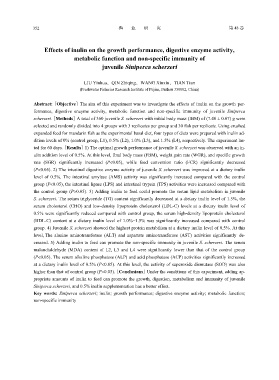
                    Effects of inulin on the growth performance, digestive enzyme activity,
                                 metabolic function and non-specific immunity of
                                             juvenile Siniperca scherzeri


                                     LIU Yinhua,QIN Zhiqing,WANG Xinxin,TIAN Tian
                                   (Freshwater Fisheries Research Institute of Fujian, Fuzhou 350002, China)


               Abstract: [Objective] The aim of this experiment was to investigate the effects of inulin on the growth per-
               formance,  digestive  enzyme  activity,  metabolic  function  and  non-specific  immunity  of  juvenile  Siniperca
               scherzeri. [Methods] A total of 360 juvenile S. scherzeri with initial body mass (IBM) of (7.40 ± 0.07) g were
               selected and randomly divided into 4 groups with 3 replicates per group and 30 fish per replicate. Using crushed
               expanded feed for mandarin fish as the experimental basal diet, four types of diets were prepared with inulin ad-
               dition levels of 0% (control group, L1), 0.5% (L2), 1.0% (L3), and 1.5% (L4), respectively. The experiment las-
               ted for 60 days. [Results] 1) The optimal growth performance of juvenile S. scherzeri was observed with an in-
               ulin addition level of 0.5%. At this level, final body mass (FBM), weight gain rate (WGR), and specific growth
               rate  (SGR)  significantly  increased  (P<0.05),  while  feed  conversion  ratio  (FCR)  significantly  decreased
               (P<0.05). 2) The intestinal digestive enzyme activity of juvenile S. scherzeri was improved at a dietary inulin
               level  of  0.5%.  The  intestinal  amylase  (AMS)  activity  was  significantly  increased  compared  with  the  control
               group (P<0.05), the intestinal lipase (LPS) and intestinal trypsin (TPS) activities were increased compared with
               the  control  group  (P>0.05).  3)  Adding  inulin  to  feed  could  promote  the  serum  lipid  metabolism  in  juvenile
               S. scherzeri. The setum triglyceride (TG) content significantly decreased at a dietary inulin level of 1.5%, the
               serum  cholesterol  (CHO)  and  low-density  lipoprotein  cholesterol  (LDL-C)  levels  at  a  dietary  inulin  level  of
               0.5% were significantly reduced compared with control group, the serum high-density lipoprotein cholesterol
               (HDL-C)  content  at  a  dietary  inulin  level  of  1.0%−1.5%  was  significantly  increased  compared  with  control
               group. 4) Juvenile S. scherzeri showed the highest protein metabilism at a dietary inulin level of 0.5%. At this
               level, The  alanine  aminotransferase  (ALT)  and  aspartate  aminotransferase  (AST)  activities  significantly   de-
               creased. 5) Adding inulin to feed can promote the non-specific immunity in juvenile S. scherzeri. The serum
               malondialdehyde  (MDA)  content  of  L2,  L3  and  L4  were  significantly  lower  than  that  of  the  control  group
               (P<0.05). The serum alkaline phosphatase (ALP) and acid phosphatase (ACP) activities significantly increased
               at a dietary inulin level of 0.5% (P<0.05). At this level, the activity of superoxide dismutase (SOD) was also
               higher than that of control group (P>0.05). [Conclusions] Under the conditions of this experiment, adding ap-
               propriate amounts of inulin to feed can promote the growth, digestion, metabolism and immunity of juvenile
               Siniperca scherzeri, and 0.5% inulin supplementation has a better effect.
               Key  words:  Siniperca  scherzeri;  inulin;  growth  performance;  digestive  enzyme  activity;  metabolic  function;
               non-specific immunity

