


Page 10 - 《渔业研究》2025年第5期
P. 10
第 5 期                    何暮春等: 贝类血淋巴细胞及其增殖、分化和死亡                                       551


                       贝类血淋巴细胞的结构与功能特征及分类                                贝类血淋巴细胞的增殖与分化

                   细胞结构                                          细胞增殖
                                                                            HGFR
                                                                   TLR3
                                                                      RUNX  CDK2
                                                                      GATA  CDC6
                                                                      SCL  CDC45
                                                                     Brachyury
                       圆形细胞,   无颗粒,                                          IL-17R1
                 有伪足                 含丰富细胞器     充满致密颗粒
                       细胞核大    大空泡                                            IL-17-1
                   细胞功能                                               细胞分化
                1                     2                               1
                                   释放
                                   ROS
                                   分泌
                                   TNF,               贝类血淋巴细胞及           无粒细胞      半粒细胞
                                   ILs  贝壳再生         其增殖、分化和死亡                                   颗粒细胞
                  病原识别     细胞吞噬          与修复
                                                                               2
                   细胞分类                                                              Ub
                                                                                    CHIP
                                                                                   RUNX  Ub
                                                                                      PCNA
                                                                                   RUNX  Integrin α4
                                                                                     无粒细胞
                                         炎性程序性细胞死亡                   非炎性程序性细胞死亡                  颗粒细胞
                 无粒细胞      半粒细胞
                                细胞焦亡          铜死亡           铁死亡          细胞自噬        细胞凋亡
                                                       Erastin  SLC3A2
                                      伊利司莫 Cu 2+  SLC31A1
                                                             AIFM2
                                                    ATP7A SLC7A11  ATG16L1
                                     Caspase-1               ESCRT-Ⅲ  ROS
                             GSDME   Caspase-3  FDX1  Fe-S  胱氨酸     AMP        溶酶体降解         Caspase-3
                                            Cu +  DLAT  TCA  半胱氨酸  铁死亡  ROS                  Caspase-5
                 颗粒细胞                           s s  Pyruvate  GSH  GPX4                       TNF
                         炎性因子                 ssss            脂质过氧化
                                                  贝类血淋巴细胞的程序性细胞死亡
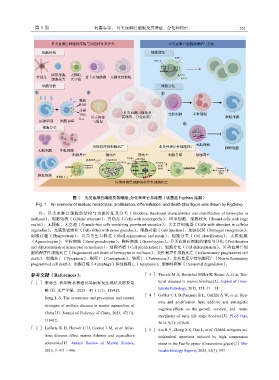
                                图 1    贝类血淋巴细胞及其增殖、分化和死亡总结图(该图由              Figdraw  绘制)
                 Fig. 1    An overview of mollusc hemocytes: proliferation, differentiation, and death (this figure was drawn by Figdraw)
                  注:贝类血淋巴细胞的结构与功能特征及分类(Structure, functional characteristics and classification of hemocytes in
              molluscs) 。细胞结构(Cellular structure) :有伪足(Cells with pseudopodia) ;圆形细胞,细胞核大(Round cells with large
              nuclei) ;无颗粒,大空泡(Granule-free cells containing prominent vacuoles) ;含丰富细胞器(Cells with abundant in cellular
              organelles) ;充满致密颗粒(Cells filled with dense granules) 。细胞功能(Cell function) :病原识别(Pathogen recognition) ;
              细胞吞噬(Phagocytosis) ;贝壳再生与修复(Shell regeneration and repair) 。细胞分类(Cell classification) :无粒细胞
              (Agranulocytes) ;半粒细胞(Semi-granulocytes) ;颗粒细胞(Granulocytes) 。贝类血淋巴细胞的增殖与分化(Proliferation
              and differentiation of hemocytes in molluscs) :细胞增殖(Cell proliferation) ;细胞分化(Cell differentiation) 。贝类血淋巴细
              胞的程序性细胞死亡(Programmed cell death of hemocytes in molluscs) :炎性程序性细胞死亡(Inflammatory programmed cell
              death) :细胞焦亡(Pyroptosis) 、铜死亡(Cuproptosis) 、铁死亡(Ferroptosis) 、非炎性程序性细胞死亡(Non-inflammatory
              programmed cell death) :细胞自噬(Autophagy)和细胞凋亡(Apoptosis) ;溶酶体降解(Lysosomal degradation) 。

                                                              [  3  ]   Travers M A, Boettcher Miller K, Roque A, et al. Bac-
              参考文献(References) :
              [  1  ]   宋林生. 我国海水养殖贝类病害发生现状及防控策                      terial diseases in marine bivalves[J]. Journal of Inver-
                    略  [J]. 水产学报,2023,47(11) :119412.                tebrate Pathology, 2015, 131: 11 − 31.
                                                              [  4  ]   Gobler C J, DePasquale E L, Griffith A W, et al. Hyp-
                    Song L S. The occurrence and prevention and control
                                                                     oxia  and  acidification  have  additive  and  synergistic
                    strategies of mollusc diseases in marine aquaculture of
                                                                     negative effects  on  the  growth,  survival,  and   meta-
                    China[J]. Journal of Fisheries of China, 2023, 47(11):
                                                                     morphosis  of  early  life  stage  bivalves[J].  PLoS  One,
                    119412.
                                                                     2014, 9(1): e83648.
              [  2  ]   Lafferty K D, Harvell C D, Conrad J M, et al. Infec-  [  5  ]   Liu R Y, Zhang X S, Gao L, et al. GABA mitigates mi-
                    tious  diseases  affect  marine  fisheries  and  aquaculture  tochondrial  apoptosis  induced  by  high  temperature
                    economics[J].  Annual  Review  of  Marine  Science,  stress in the Pacific oyster (Crassostrea gigas)[J]. Mo-
                    2015, 7: 471 − 496.                              lecular Biology Reports, 2025, 52(1): 147.

