


Page 165 - 《水产学报》2026年第04期
P. 165
4 期                                     水    产    学    报                                 50 卷


                 A comparison of fish diversity results based on eDNA metabarcoding and
                trawl net: a case study of the southern coastal waters of Zhejiang Province


                               1
                                                                                                3
                                                                                2
                                              2
                                                             2
                      CHEN Zhi  ,     JIANG Rijin  ,     LU Zhanhui  ,     ZHANG Yazhou  ,     LIU Shanshan  ,
                                                            2
                                              GAO Tianxiang  ,     LI Pengfei  2*
                          (1. Yazhou Bay Innovation Institute, Hainan Tropical Ocean University, Sanya 572022, China;
                                 2. Zhejiang Marine Fisheries Research Institute, Zhoushan 316021, China;
                                            3. BGI Research, Shenzhen 518083, China)
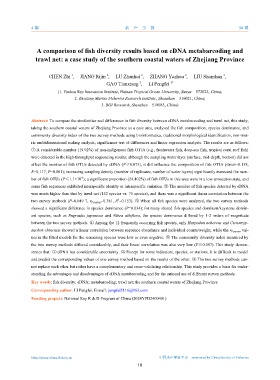
              Abstract: To compare the similarities and differences in fish diversity between eDNA metabarcoding and trawl net, this study,
              taking the southern coastal waters of Zhejiang Province as a case area, analyzed the fish composition, species dominance, and
              community diversity index of the two survey methods using bioinformatics, traditional morphological identification, non-met-
              ric multidimensional scaling analysis, significance test of differences and linear regression analysis. The results are as follows:
              ① A considerable number (19.92%) of non-indigenous fish OTUs (e.g., freshwater fish, deep-sea fish, tropical coral reef fish)
              were detected in the high-throughput sequencing results; although the sampling water layer (surface, mid-depth, bottom) did not
              affect the number of fish OTUs detected by eDNA (P≥0.073), it did influence the composition of fish OTUs (stress=0.138,
              R=0.117, P=0.001); increasing sampling density (number of replicates, number of water layers) significantly increased the num-
                                    -3
              ber of fish OTUs (P≤1.1×10 ); a significant proportion (24.402%) of fish OTUs in this area were in a low annotation state, and
              some fish sequences exhibited interspecific identity or intraspecific variation. ② The number of fish species detected by eDNA
              was much higher than that by trawl net (152 species vs. 75 species), and there was a significant linear correlation between the
                                                   2
              two survey methods (P=0.049 7, r Pearson =0.381, R =0.153). ③ When all fish species were analyzed, the two survey methods
              showed a significant difference in species dominance (P=0.034); for many shared fish species and dominant/keystone domin-
              ant  species,  such  as  Engraulis  japonicus  and  Nibea  albiflora,  the  species  dominance  differed  by  1-2  orders  of  magnitude
              between the two survey methods. ④ Among the 12 frequently occurring fish species, only Harpadon nehereus and Ctenotryp-
              auchen chinensis showed a linear correlation between sequence abundance and individual counts/weight, while the r Pearson  val-
              ues in the fitted models for the remaining species were low or even negative. ⑤ The community diversity index measured by
              the two survey methods differed considerably, and their linear correlation was also very low (P≥0.087). This study demon-
              strates that: ① eDNA has considerable uncertainty. ② Except for some indicators, species, or stations, it is difficult to model
              and predict the corresponding values of one survey method based on the results of the other. ③ The two survey methods can-
              not replace each other but rather have a complementary and cross-validating relationship. This study provides a basis for under-
              standing the advantages and disadvantages of eDNA metabarcoding and for the rational use of different survey methods.
              Key words: fish diversity; eDNA; metabarcoding; trawl net; the southern coastal waters of Zhejiang Province

              Corresponding author: LI Pengfei. E-mail: pengfei5116@163.com
              Funding projects: National Key R & D Program of China (2024YFD2400401)


              https://www.china-fishery.cn                           中国水产学会主办    sponsored by China Society of Fisheries
                                                            16

