


Page 36 - 摩擦学学报2025年第10期
P. 36
第 10 期                 高冰鉴, 等: 悬臂梁支撑摩擦副沿轴向双向滑动摩擦行为规律研究                                      1433

                 setup, friction and wear experiments were conducted at a relative sliding velocity of 229.3 mm/s and an initial normal
                 force  of  0.4  N.  The  results  indicated  significant  differences  in  the  magnitude  of  friction  force  and  wear  volume
                 depending on the direction of sliding. Subsequently, 10 sets of bidirectional sliding experiments were conducted under
                 the same conditions, with durations ranging from 1 to 15 hours. Surface morphology after the experiments was examined
                 using a 3D optical profilers. The results showed that reverse sliding produced higher normal and friction forces, greater
                 frictional  stability,  and  had  increased  the  wear  of  the  slip  ring,  compared  to  forward  sliding,  though  the  surface
                 roughness was lower in reverse motion. Further analysis revealed that as the normal force increased, the deformation of
                 asperities also increased, leading to additional frictional heat and subsequent material softening. Under low-speed, low-
                 load conditions, the effect of temperature rise was minimal, and the normal force was the dominant factor. Consequently,
                 the contact area expanded, which increased the friction force and wear, intensifying the stick-slip phenomenon. The
                 increased wear volume caused the surface texture of the slip ring to disappear, leading to the lower roughness observed
                 in reverse motion. Additionally, the study found an approximately linear negative correlation between the normal force
                 and friction force during the friction process, with a proportional coefficient of −2.316. To explain this observation, a
                 simplified  two-dimensional  contact  model  was  developed  based  on  the  experimental  samples.  Using  the  small
                 deformation theory of material mechanics and ignoring higher-order terms, force-deformation equations were derived,
                 and structural parameters were incorporated to establish the relationship between changes in normal force and friction
                 force.  The  computed  results  showed  a  linear  negative  correlation,  with  a  proportional  coefficient  of  −2.356,  which
                 closely matched the experimental data. This study highlighted a significant deviation between the initial static normal
                 force and the actual dynamic normal force in cantilever beam contact friction pairs during operation. This deviation had
                 important implications for controlling operating conditions in friction systems. Therefore, when setting the preload, it
                 was  essential  to  consider  the  effects  of  this  deviation  on  normal  force  and  how  it  influences  friction  and  wear
                 characteristics.
                 Key words: cantilever beam support; axial motion; bidirectional sliding; friction-normal force coupling; small
                 deformation assumption

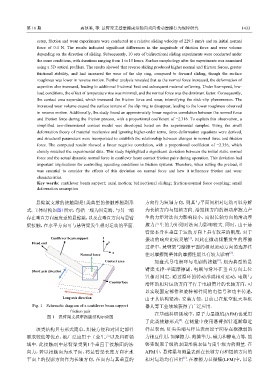
                悬臂梁支撑的接触副是1类典型的接触摩擦副形                          方向作为短轴方向,则其与平面间相对运动可以分解
            式,主体结构如图1所示,包括一端为固定端、与另一端                          为长轴方向与短轴方向. 沿短轴方向的滑动摩擦力产
            存在垂直方向高度差的悬臂梁,以及在垂直方向与悬臂                           生的力矩对法向力影响较小,而沿长轴方向的滑动摩

            梁接触、在水平方向可与悬臂梁发生相对运动的平面.                           擦力产生的力矩则对法向力影响较大. 同时,由于悬
                                                               臂梁本身在垂直于运动方向上具有较差的刚度,对于

                       Cantilever beam support  z              振动的响应比较灵敏 ,因此在微动频繁发生的摩擦
                                                                                 [1]
               Fixed end                       y
                                                               过程中,悬臂梁与摩擦平面的相对运动方向的选择往
                                                 x                                                 [2]
                                   Normal force                往对摩擦副整体的摩擦性能具有较大影响 .
                                              Contact area         如盘式导电滑环与电刷的接触 ,则为典型的悬
                                                                                              [3]
               Short axis direction                            臂梁支撑-平面摩擦副,电刷与滑环在垂直方向上位
                                                               置相对固定,通过滑环的转动形成相对运动,电刷与
                                                Counterface
                                                               滑环的相对运动方向平行于电刷簧片的长轴方向,可
                                                               以实现固定部件和旋转部件间的电信号和功率传递,
                            Long axis direction                由于其结构紧凑,安装方便,目前已在航空航天和机

               Fig. 1    Schematic diagram of a cantilever beam support  器人等工业领域获得了广泛应用.
                               friction pair                       在基础科研领域中,原子力显微镜(AFM)也采用
                     图 1    悬臂梁支撑摩擦副结构示意图
                                                                             [4]
                                                               了此类接触形式 . 在测量中使用悬臂探针逐渐靠近
                该类结构具有形式简单、组装方便和对固定部件                          样品表面,针尖尖端与样品表面原子间存在极微弱的
            要求较低等优点,被广泛应用于工业生产以及科研领                            力相互作用,如摩擦力、范德华力、磁力和静电力等,能
            域中. 此接触副中悬臂梁受到1个垂直于接触面的法                           够实现原子级的表面形貌表征与皮牛级力的测量. 在
            向力,若以接触面为水平面,将悬臂梁长度方向在水                            AFM中,悬臂梁与测量表面在长轴方向和短轴方向的
                                                                               [5]
            平面上的投影方向作为长轴方向,在面内与其垂直的                            相对运动均有应用 . 在摩擦力显微镜(LFM)中,以悬

