


Page 72 - 《爆炸与冲击》2026年第11期
P. 72
第 46 卷         王帅帅,等: 数据驱动的箍筋加密钢筋混凝土柱爆炸损伤预测与评估模型                               第 11 期


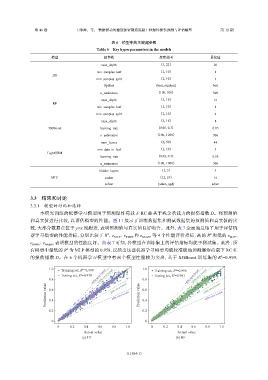
                                                   表 6    模型中的关键超参数
                                            Table 6    Key hyperparameters in the models
                        模型                     超参数                      搜索范围                  最优值

                                              max_depth                  (3, 21)                20
                                            min_samples_leaf             (1, 10)                1
                        DT
                                            min_samples_split            (2, 10)                3
                                               Splitter               {best, random}           best
                                              n_estimators             (100, 500)               500
                                              max_depth                  (3, 16)                16
                        RF
                                            min_samples_leaf             (1, 10)                1
                                            min_samples_split            (2, 10)                2
                                              max_depth                  (3, 16)                8
                       XGBoost               learning_rate             (0.05, 0.3)             0.05
                                              n_estimators             (100, 1 200)             700
                                              num_leaves                 (6, 50)                44
                                            min_data_in_leaf             (1, 10)                3
                      LightGBM
                                             learning_rate             (0.05, 0.3)             0.05
                                              n_estimators             (100, 1 000)             700
                                             hidden_layers               (1, 5)                 3
                        MLP                     nodes                   (12, 24)                16
                                                solver                 {adam, sgd}             adam

                3.3    结果和讨论
                3.3.1    模型的对比和选择
                   本研究训练的机器学习模型用于预测爆炸荷载下                        RC  柱基于残余承载力的损伤指数              D。将预测值
               和真实值进行比较,以评估模型的性能。图                    11  展示了训练数据集和测试数据集的预测值和真实值的比
               较,大部分数据点位于          y=x 线附近,表明预测值与真实值良好吻合。此外,表                     7  全面地总结了用于评估机
               器学习模型的性能指标,分别比较了                R 、e MAE 、e RMS E  和  e MedA E  等  4  个性能评价指标,高的  R 和低的  e MAE 、
                                                 2
                                                                                              2
               e RMSE 、e MedA E  表明模型的性能良好。由表      7  可知,各模型在训练集上的评估指标均优于测试集。此外,所
               有模型中最低的       R 为 2  MLP  模型的  0.958,反映出这些机器学习模型均能较准确地预测爆炸荷载下                         RC  柱
               的损伤指数      D。在   6  个机器学习模型中有两个模型性能较为突出,基于                       XGBoost 训练集的      R =0.999,
                                                                                                   2

                       1.0                                      1.0
                                      2
                                                                               2
                             Training set, R =0.998                   Training set, R =0.996
                                                                              2
                             Testing set, R =0.970  +20% error bound   Testing set, R =0.981  +20% error bound
                                     2
                       0.8                +40% error bound      0.8                +40% error bound
                     Prediction value  0.6        −20% error bound  Prediction value  0.6  −20% error bound
                                                  −40% error bound
                                                                                            −40% error bound
                                                                0.4
                       0.4
                       0.2                                      0.2
                        0                                        0
                          0     0.2   0.4   0.6    0.8   1.0        0     0.2   0.4   0.6   0.8   1.0
                                      Actual value                              Actual value
                                      (a) DT                                   (b) RF


                                                         111504-13
                                                  −20% error bound                         −20% error bound
                                                  −40% error bound                          −40% error bound


                                                  −20% error bound                         −20% error bound

                                                  −40% error bound                          −40% error bound

