


Page 21 - 《爆炸与冲击》2026年第2期
P. 21
第 46 卷       黄    阳,等: 反应平衡对TNT约束爆炸准静态压力热力学模型计算结果的影响                            第 2 期


               to  investigate  the  influence  of  reaction  equilibrium  on  thermodynamic  calculation  results,  the  model  neglecting  reaction
               equilibrium was modified based on the energy conservation equation of isochoric processes and the solid carbon precipitation
                                                                                    3
               phenomenon. The modified model has a consistency with the UFC curve for m/V≥0.371 kg/m . Then, a comparative analysis
               was conducted on the results of thermodynamic models considering and not considering the reaction equilibrium based on the
               unified solution framework. The results indicate that incorporating chemical equilibrium into quasi-static pressure calculation
               introduces a maximum relative deviation below 20%, and critical thresholds alters, i.e., the m/V for carbon precipitation shifts
                                                                                 3
                                  3
               from  0.371  to  3.850  kg/m ,  and  peak  temperature  transitions  from  0.371  to  0.680  kg/m .  Significant  divergence  in  mole
                                                                              3
               numbers  of  product  composition  emerges  progressively  when  m/V  exceeds  0.1  kg/m .  Therefore,  the  reaction  equilibrium-
               based thermodynamic model is a more rational choice for calculating quantities related to components and temperature in TNT
                                             3
               confined explosions with m/V>0.1 kg/m . Finally, a simplified calculation method for products, temperature, and pressure
               during  the  quasi-static  phase  of  TNT  confined  explosions  considering  reaction  equilibrium  is  proposed  based  on  symbolic
               regression algorithm. The research contributes to a theoretical understanding of equilibrium effects on thermodynamic model
               results and the practical implementation of rapid parameter estimation in TNT confined explosion scenarios.
               Keywords:  chemical reaction equilibrium; confined explosion; quasi-static pressure; thermodynamic model

                   约束空间中,炸药爆炸受空间约束作用,常在空间角部表现出冲击波汇聚现象,并伴随明显的热效
               应,它们通过冲击波传播时的壁面反射压力和流场趋于稳定后的准静态压力对结构造成毁伤。对于
               TNT  等负氧平衡炸药,爆轰产物还可与空间中的氧气混合并燃烧,发生后燃效应,进而升高空间温度,增
               大壁面荷载,造成更严重的破坏              [1-2] 。约束爆炸的准静态阶段作用时间长,准静态压力受后燃影响显著,
               且与壁面结构响应强相关            [3-5] 。实现约束爆炸准静态阶段热力学状态的准确计算,对结构抗内爆设计及
               结构损伤评估具有重要意义。
                   当前,TNT    被广泛用于结构内爆炸试验研                         10
                                                                                [6]
               究及工程抗爆设计中。针对              TNT  约束爆炸,国                    Weibull, et al
                                                                        Wang, et al [8]
               内外学者开展了一系列试验和数值研究。已有                                     Kong, et al [2]
                                                                        Xu, et al [11]
               的试验研究主要基于完全封闭箱体开展了不同                                 1   Zhou, et al [13]
               当量体积比     m/V(m  为炸药当量,V      为约束空间体              Δp/MPa
               积)的  TNT  约束爆炸试验,并测定了准静态阶段                                                  Zhang, et al [7]
                                                                                           Zhang, et al [9]
               的压力和温度等热力学参数。图                1  展示了部分                                      Kong, et al [10]
                                                                   0.1                     Li, et al [12]
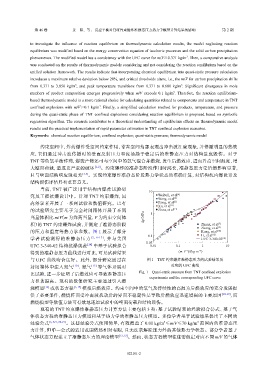
               学  者  试  验  测  得  的  准  静  态  压  力  [2, 6-13] , 并  与  美  国                  UFC 3-340-02 [14]
                                                                  0.05
               UFC 3-340-02  结构抗爆规范     [14]  中基于试验拟合               0.01       0.1         1         10
                                                                                         −3
                                                                                    −1
               得到的准静态压力曲线进行对比,可见试验结果                                            (m·V )/(kg·m )
               与  UFC  曲线吻合良好。此外,部分研究通过在                          图 1    TNT  约束爆炸准静态压力的试验结果及
               封闭箱体中注入氦气          [10] 、氮气 [15]  等气体开展对                      对应的  UFC  曲线
               比试验,进一步证明了后燃效应可导致准静态压                           Fig. 1    Quasi-static pressure from TNT confined explosion
                                                                   experiments and the corresponding UFC curve
               力显著提高。现有的数值研究主要通过引入燃
               烧模型   [16]  或状态方程  [1, 17]  模拟后燃效应。约束空间中的氧气及持续性的高温为后燃效应的充分发展提
               供了必要条件,燃烧阵面受冲击波扰动后的界面不稳定性是导致后燃效应迅速增强的主要原因                                            [18-19] ,而
               燃烧模型等数值方法可有效地还原试验中的壁面荷载和结构毁伤。
                   现有的    TNT  约束爆炸准静态压力计算方法主要包括                  3  类:基于试验结果的经验拟合公式、基于气
               体状态方程的准静态压力模型和基于热力学的准静态压力模型。多位学者基于试验结果提出了不同的
                                                                                         3
               经验公式    [6, 8-9, 20-21] 。这些经验公式使用简单,有效覆盖了         0.01 kg/m ≤m/V≤70 kg/m 范围内的准静态压
                                                                          3
               力计算,但单一公式的适用范围依然相对有限,且无法求解除压力外的其他热力学状态。部分学者基于
               气体状态方程建立了准静态压力的理论模型                    [12, 22] 。然而,状态方程模型往往需假定对应不同               m/V  的气体


                                                         022101-2

