


Page 156 - 《水产学报》2026年第2期
P. 156
2 期             PASSMORE Roland Madziva,等:银灰半棱鳀仔稚鱼的脊柱和附肢骨骼发育                             50 卷


                                                               ence  and  the  environmental  conditions  that,  in  turn,
                 Sn
                                                               influence  the  genetic  regulation  of  bone  formation,
                           Na                                  which varies among species [37-39] .
                                                                   Uroneural  1  appears  to  fuse  with  the  preural
                                                               centrum  1  to  form  a  pleurostyle.  The  presence  of  a
                                                               pleurostyle  is  well  recorded  in  clupeoid  fishes [27,  29] .
               0.25 mm                                    1    However,  its  presence  in  ostarioclupeomorphs  and
                                                               some  euteleosts  is  yet  to  be  clarified,  and  extensive
                  Na
                                                                                                        [40]
                                                               research is needed in different teleostean subgroups .
                                     Sn
                                                               Since  the  skeletal  elements  forming  the  pleurostyle
                                                               differ among different fish groups, the structure is not
                                                               homologous but rather a different morphological char-
                                                               acteristic [34-35] , and this poses a difficulty in its defini-
               0.25 mm            Pa                      2    tion. In E. punctifer, epurals initially appeared as sep-
                                                               arate structures, but later, Ep1 and Ep2 fused forming
                                                               an  anterior-dorsal  compound  epural.  A  compound
                                                                                               [30]
                           Sn                                  epural has been reported in E. japonicus  and in other
                                                                                                        [31]
                                                               clupeoid  species  such  as  Sprattus  sprattus .
                                              Ns
                                                               However, the number of epurals varies among Clupei-
                                                                                                    [19]
                                                               formes members. For instance, in C. harengus , only
                 1.00 mm                                  3    2 epurals form and such fusions have not been docu-

                                                               mented.
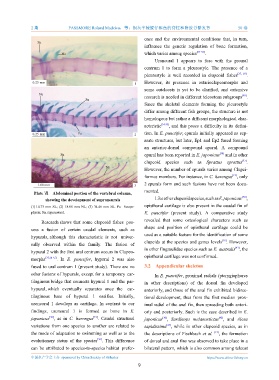
                Plate Ⅶ Abdominal portion of the vertebral column,
                                                                                                        [30]
                                                                   Like other clupeoid species, such as E. japonicus  ,
                    showing the development of supraneurals
              (1) 14.73  mm  SL;  (2)  18.08  mm  NL;  (3)  34.46  mm  SL.  Pa.   Parapo-  opisthural cartilage is also present in the caudal fin of
              physis; Sn. supraneural.                         E.  punctifer  (present  study).  A  comparative  study
                                                               revealed  that  some  osteological  characters  such  as
                   Research shows  that  some  clupeoid  fishes   pos-
                                                               shape  and  position  of  opisthural  cartilage  could  be
              sess  a  fusion  of  certain  caudal  elements,  such  as
                                                               used as a suitable feature for the identification of some
              hypurals, although  this  characteristic  is  not   univer-
                                                                                                [18]
                                                               clupeids at the species and genus levels . However,
              sally  observed  within  the  family.  The  fusion  of
                                                                                                     [41]
                                                               in other Engraulidae species such as E. australis , the
              hypural 2 with the first ural centrum occurs in Clupeo-
                                                               opisthural cartilage was not confirmed.
              morpha [27,34-35] .  In  E.  punctifer,  hypural  2  was  also
              fused to ural centrum 1 (present study). There are no   3.2    Appendicular skeleton
              other fusions of hypurals, except for a temporary car-  In E. punctifer, proximal radials (pterygiophores
              tilaginous bridge that connects hypural 1 and the par-  in  other  descriptions)  of  the  dorsal  fin  developed
              hypural, which  eventually  separates  once  the   car-  anteriorly, and those of the anal fin exhibited bidirec-
              tilaginous  base  of  hypural  1  ossifies.  Initially,  tional development,  thus  from  the  first  median   prox-
              uroneural  1  develops  as  cartilage.  In  contrast  to  our  imal radial of the anal fin, then spreading both anteri-
              findings,  uroneural  1  is  formed  as  bone  in  E.  orly and posteriorly. Such is the case described in E.
                                         [19]
                      [30]
                                                                                              [42]
                                                                      [30]
              japonicus ,  as  in  C.  harengus .  Caudal  structural  japonicus ,  Sardinops  melanostictus ,  and  Alosa
              variations  from  one  species  to  another  are  related  to  sapidissima ,  while  in  other  clupeoid  species,  as  in
                                                                        [43]
              the mode of adaptation to swimming as well as to the  the descriptions of Fischbach et al.   [19] , the formation
                                           [36]
              evolutionary  status  of  the  species .  This  difference  of dorsal and anal fins was observed to take place in a
              can  be  attributed  to  species-to-species habitat   prefer-  bilateral pattern, which is also common among teleost
              中国水产学会主办  sponsored by China Society of Fisheries                          https://www.china-fishery.cn
                                                            9

