


Page 183 - 《水产学报》2025年第12期
P. 183
张金叶,等                                                                水产学报, 2025, 49(12): 129414


                     5 mm        1  250 μm                    2   5 μm            3   5 μm           4


                     5 μm                5    5 μm               6   5 μm                            7

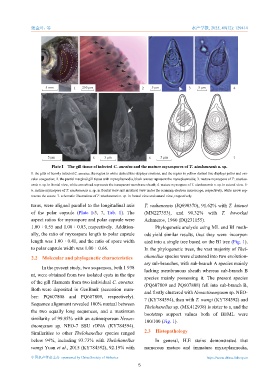
                       Plate I The gill tissue of infected C. auratus and the mature myxospores of T. xiushanensis n. sp.
              1. the gills of heavily infected C. auratus, the region in white dashed line displays erosions, and the region in yellow dashed line displays pallor and vas-
              cular congestion; 2. the partial marginal gill tissue with myxoplasmodia, black arrows represent the myxoplasmodia; 3. mature myxospore of T. xiushan-
              ensis n. sp. in frontal view, white arrowhead represents the transparent membrane sheath; 4. mature myxospore of T. xiushanensis n. sp. in sutural view. 5-
              6. mature myxospore of T. xiushanensis n. sp. in frontal view and insutural view under the scanning electron microscope, respectively, white arrow rep-
              resents the suture. 7. schematic illustrations of T. xiushanensis n. sp. in frontal view and sutural view, respectively.
              turns, were aligned parallel to the longitudinal axis  T. wuhanensis (JQ690370), 91.62% with T. kitauei
              of  the  polar  capsule  (Plate  I-3,  7,  Tab.  1).  The  (MN227353),  and  90.32%  with  T.  hovorkai
              aspect ratios for myxospore and polar capsule were  Achmerov, 1960 (DQ231155).
              1.00∶0.55 and 1.00∶0.83, respectively. Addition-     Phylogenetic analysis using ML and BI meth-
              ally, the ratio of myxospore length to polar capsule  ods yield  similar  results,  thus  they  were   incorpor-
              length was 1.00∶0.41, and the ratio of spore width  ated into a single tree based on the BI tree (Fig. 1).
              to polar capsule width was 1.00∶0.66.            In the phylogenetic trees, the vast majority of Thel-
               2.2    Molecular and phylogenetic characteristics  ohanellus species were clustered into two evolution-
                                                               ary sub-branches, with sub-branch A species mainly
                   In the present study, two sequences, both 1 938
                                                               lacking membranous sheath whereas sub-branch B
              nt, were obtained from two isolated cysts in the tips
                                                               species  mainly  possessing  it.  The  present  species
              of the gill filaments from two individual C. auratus.
                                                               (PQ607809 and PQ607808) fell into sub-branch B,
              Both were  deposited  in  GenBank  (accession   num-
                                                               and firstly clustered with Neoactinomyxum sp. NEO-
              ber:  PQ607808  and  PQ607809,  respectively).
                                                               7 (KY784594), then with T. wangi (KY784592) and
              Sequence alignment revealed 100% mutual between
                                                               Thelohanellus sp. (MK412938) is sister to a, and the
              the  two  equally  long  sequences,  and  a  maximum
                                                               bootstrap  support  values  both  of  BI/ML  were
              similarity of 99.95% with an actinosporean Neoac-
                                                               100/100 (Fig. 1).
              tinomyxum  sp.  NEO-7  SSU  rDNA  (KY784594).
                                                                2.3    Histopathology
              Similarities  to  other  Thelohanellus  species  ranged
              below  94%,  including  93.73%  with  Thelohanellus  In  general,  H.E  stains  demonstrated  that
              wangi Yuan et al., 2015 (KY784592), 92.19% with  numerous  mature  and  immature  myxoplasmodia,

              中国水产学会主办  sponsored by China Society of Fisheries                          https://www.china-fishery.cn
                                                            5

