


Page 185 - 《水产学报》2025年第12期
P. 185
张金叶,等                                                                水产学报, 2025, 49(12): 129414


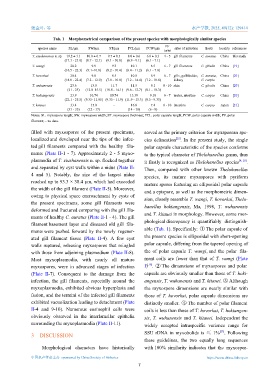
                        Tab. 1    Morphometrical comparison of the present species with morphologically similar species
                                                                        PF
                 species name  SL/μm   SW/μm    ST/μm   PCL/μm  PCW/μm      sites of infection  hosts  locality references
                                                                       turns
               T. xiushanensis n. sp.  19.2 ± 1.1  10.0 ± 0.7  9.7 ± 0.5  8.0 ± 0.6  6.6 ± 0.3  4 - 5 gill filaments  C. auratus  China  this study
                             (17.1 - 21.0)  (8.7 - 12.1)  (9.1 - 10.8)  (6.9 - 9.1)  (6.1 - 7.1)
               T. wangi        20.2     9.9      9.3     10.1    6.5   6 - 7 gill filaments  C. gibelio  China  [19]
                             (16.5 - 22.3)  (9.1–10.8)  (8.2 - 10.4)  (8.4 - 11.2)  (6.1 - 7.0)
               T. hovorkai     20.4     9.8      8.5     10.8    8.9   6 - 7 gills, gallbladder, C. auratus, China  [20]
                             (18.0 - 22.4)  (7.2 - 12.0)  (7.0 - 10.0)  (7.2 - 14.4) (7.2 - 10.8)  kidney  C. carpio
               T. wuhanensis   23.6     13.8    11.7     11.5    9.1   8 - 10 skin     C. gibelio  China  [20]
                              (21 - 25)  (12.0–15.5) (10.8 - 14.1) (9.6 - 12.7) (8.1 - 10.3)
               T. hokiangensis  23.9   10.74    10.74   13.39    9.18  6 - 7 ureter, intestine  C. carpio  China  [20]
                             (22.1 - 25.5) (9.35- 11.05) (9.35 - 11.9) (11.9 - 15.3) (8.5 - 9.35)
               T. kitauei      33.4     15.0     -       16.8    7.4   8 - 10 intestine  C. carpio  Japan  [21]
                              (31 - 35)  (12 - 17)      (14 - 18)  (6 - 9)
              Notes: SL. myxospore length; SW. myxospore width; ST. myxospore thickness; PCL. polar capsule length; PCW. polar capsule width; PF. polar
              filament; -. no data.

              filled  with  myxospores  of  the  present  specimens,  served as the primary criterion for myxsporean spe-
              localized and developed near the tips of the infec-  cies  delineation .  In  the  present  study,  the  single
                                                                            [22]
              ted gill  filaments  compared  with  the  healthy   fila-  polar capsule characteristic of the species conforms
              ments (Plate II-1 - 7). Approximately 2 - 5 myxo-  to the typical character of Thelohanellus genus, thus
              plasmodia of T. xiushanensis n. sp. flocked together                                     [4, 20]
                                                               it firstly is recognized as Thelohanellus species  .
              and separated by cyst walls within a nidus (Plate II-
                                                               Then,  compared  with  other  known  Thelohanellus
              4  and  5).  Notably,  the  size  of  the  largest  nidus
                                                               species,  its  mature  myxospores  with  pyriform
              reached up to 93.3 × 38.4 μm, which had exceeded
                                                               mature spores featuring an ellipsoidal polar capsule
              the width of the gill filament (Plate II-5). Moreover,
                                                               and a epispore, as well as the morphometric dimen-
              owing to physical space encroachment by cysts of
                                                               sion, closely resemble T. wangi, T. hovorkai, Thelo-
              the  present  specimens,  some  gill  filaments  were
                                                               hanellus  hokiangensis,  Ma,  1998,  T.  wuhanensis
              deformed and fractured comparing with the gill fila-
                                                               and T. kitauei in morphology. However, some mor-
              ments of healthy C. auratus (Plate II-1 - 4). The gill
                                                               phological discrepancy  is  quantifiably   distinguish-
              filament basement  layer  and  diseased  old  gill   fila-
                                                               able (Tab. 1). Specifically: ① The polar capsule of
              ments were pushed forward by the newly regener-
                                                               the present species is ellipsoidal with short-opening
              ated  gill  filament  tissue  (Plate  II-4).  A  few  cyst
                                                               polar capsule, differing from the tapered opening of
              walls  ruptured,  releasing  myxospores  that  mingled
              with those from adjoining plasmodium (Plate II-8).  the  of  polar  capsule  T.  wangi, and  the  polar   fila-
              Most  myxoplasmodia,  with  nearly  all  mature  ment  coils  are  fewer  than  that  of  T.  wangi  (Plate
                                                                [19]
              myxospores,  were  in  advanced  stages  of  infection  I) .  ② The  dimensions  of  myxospores  and  polar
              (Plate  II-7).  Consequent  to  the  damage  from  the  capsule are obviously smaller than those of T. hoki-
              infection,  the  gill  filaments,  especially  around  the  angensis, T. wuhanensis and T. kitauei. ③ Although
              myxoplasmodia, exhibited obvious hyperplasia and  the  myxospore  dimensions  are  nearly  similar  with
              fusion, and the termini of the infected gill filaments  those of T. hovorkai, polar capsule dimensions are
              exhibited vacuolization leading to detachment (Plate  distinctly smaller. ④ The number of polar filament
              II-4  and  9-10).  Numerous  eosinophil  cells  were  coils is less than those of T. hovorkai, T. hokiangen-
              obviously  observed  in  the  interlamellar  epithelia  sis,  T.  wuhanensis  and  T.  kitauei.  Independent  the
              surrounding the myxoplasmodia (Plate II-11).     widely  accepted  intraspecific  variance  range  for

                                                                                               [23]
                                                               SSU  rDNA  in  myxobolids  is  ≤  1% .  Following
               3    DISCUSSION
                                                               these  guidelines,  the  two  equally  long  sequences
                   Morphological  characters  have  historically  with 100%  similarity  indicates  that  the   myxospor-

              中国水产学会主办  sponsored by China Society of Fisheries                          https://www.china-fishery.cn
                                                            7

