


Page 16 - 摩擦学学报2025年第8期
P. 16
1114                                   摩擦学学报(中英文)                                        第 45 卷

                 service. In this study, the investigation of the tribological properties of domestic high-chromium martensitic stainless
                 steels  (9Cr18  and  9Cr18MoV)  with  antimony-impregnated  graphite  using  a  multifunctional  friction  and  wear  tester
                 provided  a  basis  for  the  material  selection  of  domestic  chromium  steel  sealing  rings.  Microscopic  morphology  and
                 composition analysis techniques, including confocal laser scanning microscope, scanning electron microscopy, energy-
                 dispersive  X-ray  spectroscopy,  X-ray  photoelectron  spectroscopy,  and  phase  analysis  of  X-ray  diffraction, were
                 employed to investigate the wear mechanism. The results of the reciprocating sliding wear test conducted in a ball-on-
                 flat contact configuration showed that the tribological behavior of 9Cr18MoV was similar to that of the imported high-
                 chromium martensitic stainless steel. Under oil lubrication, the friction coefficient of 9Cr18MoV was stable and slightly
                 lower than that of the imported Cr alloy, with no significant wear traces observed on the worn surfaces of either stainless
                 steel, except for a few shallow scrapes. The friction coefficient of 9Cr18 fluctuated significantly, and its worn surface
                 exhibited obvious plastic deformation. Under dry conditions, the variation in friction coefficient over sliding time and
                 the average friction coefficient of 9Cr18MoV aligned with those for the imported Cr alloy, while 9Cr18 exhibited a
                 longer running-in time and a higher average friction coefficient. Furthermore, friction and wear tests were conducted on
                 the sliding contact between a pin-on-disc, comparing the friction and wear behavior of two domestic stainless steels,
                 9Cr18 and 9Cr18MoV, under different contact stresses (1.0, 1.5, 2.0, 2.5, 3.0 MPa) and linear velocities (0.4, 0.7, 1.0,
                 1.3, 1.6 m/s). The results indicated that as contact stress and linear velocity increased, wear traces on both 9Cr18 and
                 9Cr18MoV surfaces became more pronounced, accompanied by a rise in contact interface temperature. Notably, under
                 the given linear velocities, contact stresses, and lubrication conditions, the 9Cr18MoV surface exhibited a low friction
                 coefficient with minimal fluctuations, slight surface wear, and a smaller temperature rise compared to the 9Cr18 surface.
                 Under  oil  lubrication,  the  primary  wear  mechanism  of  both  stainless  steels  was  abrasive  wear,  while  under  dry
                 conditions, wear was dominated by the transfer of counterpart material, accompanied by the oxidation of metallic Sb to
                 form  Sb 2 O 5   during  the  transfer  process.  Upon  further  analysis,  it  became  evident  that  the  exceptional  tribological
                 properties of the 9Cr18MoV were closely linked to its microstructure and chemical composition. The trace elements Mo
                 and V in 9Cr18MoV refined the grains and promoted the precipitation of large-particle carbides at the grain boundaries,
                 thereby  enhancing  the  material’s  resistance  to  deformation  and  damage,  reducing  the  risk  of  hard  carbide  particles
                 detaching during friction and wear, and consequently improving the material’s wear resistance. In summary, 9Cr18MoV
                 had excellent tribological properties, demonstrating great promise for mechanical seal applications.
                 Key words: mechanical seal; high chromium martensitic stainless steel; friction and wear; grain refinement; carbide

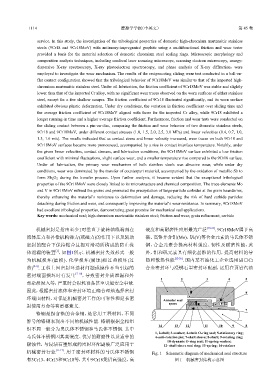
                机械密封是指由至少1对垂直于旋转轴线端面在                          硬度和高耐磨性应用最为广泛             [18-21] . 9Cr18MoV属于高
            流体压力和补偿机构弹力(或磁力)的作用下以及辅助                           碳、高铬并含钼(Mo)、钒(V)等合金元素的马氏体不锈
            密封的配合下保持贴合且相对滑动所构成的防止流                             钢,合金元素会提高材料强度、韧性及耐磨性能,此
            体泄漏的装置 ,如图1所示. 机械密封失效形式一般                          外,钼和矾元素具有细化晶粒的作用,提高材料的导
                         [1]
            为机械损坏(磨损)、化学损坏(腐蚀)和过热损坏(过                          热和散热性能      [22-26] . 国内某石油化工企业选用进口Cr

            热) [2-4] . 工程上因密封环选材问题或操作不当引起的                     合金密封环与浸锑石墨密封环配副,运用在页岩汽油
            密封端面损坏时有发生           [5-10] ,导致密封介质泄漏和外
                                                                     1        2          3        4      5
            部杂质浸入等,严重时会损耗设备甚至引起安全事故.
            因此,根据密封流体和密封环境正确合理地选择密封                                                                      6
            环端面材料,对保证机械密封工作的可靠性和延长密                                   Annular seal
                                                                         space
            封使用寿命等有重要意义.
                                                                                                         7
                铬钢是指含铬的合金钢,是常用工程材料,不同
            牌号的铬钢表现出不同的机械性能. 铬钢根据金相组
                                                                    14     13   12      11    10    9    8
            织不同一般分为奥氏体不锈钢和马氏体不锈钢. 其中
                                                                   1, 2-shell; 3-washer; 4-static O-ring seal; 5-stationary ring;
            马氏体不锈钢因其高硬度、优异的耐磨性以及适中的                                6-anti-rotation pin; 7-shaft sleeve; 8-shaft; 9-rotating ring;
                                                                        10-dynamic O-ring seal; 11-spring washer;
            耐蚀性,与浸渍石墨形成的密封环配副被广泛应用于                                    12- shaft sleeve seal ring; 13-spring; 14-retainer
            机械密封行业       [11-17] . 用于密封环材料的马氏体不锈钢                 Fig. 1    Schematic diagram of mechanical seal structure
            有3Cr13、4Cr13和9Cr18等,其中9Cr18凭借高强度、高                             图 1    机械密封结构示意图

