


Page 86 - 《爆炸与冲击》2026年第8期
P. 86
第 46 卷         丁肇银,等: 非金属内肋增强粉末式破门弹的侵彻效应与附带损伤特性                                 第 8 期

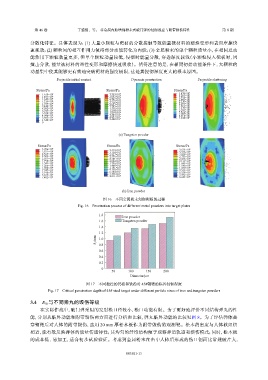
               分散化特征。具体表现为:(1) 大量小颗粒与靶材的分散接触导致能量被材料的塑性变形和表面摩擦快
               速耗散;(2) 颗粒间的相互作用力使得部分动能转化为内能;(3) 金属粉末的单个颗粒质量小,在相同总动
               能作用下颗粒数量更多,但单个颗粒动量较低,侵彻时能量分散,穿透深度较浅(小颗粒侵入靶板时,因
               撞击分散,能量被材料的塑性变形和摩擦快速吸收)。值得注意的是,在相同初始动能条件下,大颗粒的
               动量集中使其能够更有效地突破靶材的强度极限,这是其侵彻深度更大的根本原因。
                          Projectile initial contact       Dynamic penetration           Projectile shattering

                 Stress/Pa                      Stress/Pa                     Stress/Pa
                    1.618×10 8                    3.354×10 8                    3.478×10 8
                                                                                3.201×10 8
                    1.483×10 8                    3.095×10 8                    2.924×10 8
                    1.349×10 8                    2.835×10 8                    2.647×10 8
                                                  2.576×10 8
                    1.214×10 8                    2.316×10 8                    2.370×10 8
                    1.079×10 8                    2.057×10 8                    2.093×10 8
                    9.440×10 7                    1.797×10 8                    1.816×10 8
                    8.092×10 7                    1.538×10 8                    1.539×10 8
                    6.743×10 7                    1.278×10 8                    1.262×10 8
                    5.394×10 7                    1.019×10 8                    9.852×10 7
                                                                                7.083×10 7
                    4.046×10 7                    7.592×10 7                    4.314×10 7
                    2.697×10 7                    4.997×10 7                    1.544×10 7
                    1.349×10 7                    2.402×10 7
                    0
                                                      (a) Tungsten powder
                  Stress/Pa                     Stress/Pa                      Stress/Pa
                    3.076×10 8                    3.412×10 8                     3.623×10 8
                    2.821×10 8                    3.134×10 8                     3.326×10 8
                    2.565×10 8                    2.857×10 8                     3.029×10 8
                    2.309×10 8                    2.579×10 8                     2.733×10 8
                    2.053×10 8                    2.301×10 8                     2.436×10 8
                    1.798×10 8                    2.024×10 8                     2.139×10 8
                    1.542×10 8                    1.746×10 8                     1.843×10 8
                    1.286×10 8                    1.468×10 8                     1.546×10 8
                    1.030×10 8                    1.191×10 8                     1.249×10 8
                    7.747×10 7                    9.130×10 7                     9.525×10 7
                    5.190×10 7                    6.354×10 7                     6.558×10 7
                                                  3.578×10 7
                    2.632×10 7                    8.011×10 6                     3.591×10 7
                    7.482×10 5                                                   6.243×10 6
                                                       (b) Iron powder
                                               图 16    不同金属粉末侵彻靶板的过程
                                   Fig. 16    Penetration process of different metal powders into target plates

                                             1.8       Iron powder
                                             1.6       Tungsten powder
                                             1.4
                                             1.2
                                            h b/mm  1.0
                                             0.8
                                             0.6
                                             0.4
                                             0.2
                                              0
                                                   50     100     150     200
                                                           Diameter/μm
                                       图 17    不同粒径的钨粉和铁粉对      45#钢靶的临界侵彻深度
                      Fig. 17    Critical penetration depth of 45# steel target under different particle sizes of iron and tungsten powders

                    E 50  与不同弹丸的毁伤等级
                3.4
                   在实际作战中,破门弹采用的发射枪口径较小,枪口动能有限。为了更好地评价不同结构弹丸的性
               能,分别从临界动能和附带毁伤两方面进行分析和比较,弹丸临界动能的比较见图                                      8。为了评估弹体击
               穿钢靶后对人体的附带毁伤,选用               20 mm  厚松木板作为附带毁伤的观测靶。松木的密度与人体软组织
               相近,能有效反映弹体的能量传递特性;其均匀的纤维结构便于观察弹道轨迹和损伤模式;同时,松木板
               的成本低、易加工,适合初步试验验证。考虑到金属粉末在击中人体后形成的伤口创面比常规破片大,


                                                         083301-13

