


Page 93 - 《渔业研究》2025年第5期
P. 93
634                                  渔  业  研  究                                     第 47 卷

              女虫样品,进行线粒体           COⅠ基因扩增和测序,并                中,与Ⅱ级感染牡蛎相比,Ⅲ 级感染牡蛎的免疫
              与  Genbank  数据库中才女虫序列比对,结果显示样                    相关基因     SABL、lysozyme 和  C3  均出现显著下调
              品与陵水才女虫         COⅠ基因相似度均为          100%,进       (P<0.05) ;Ⅳ 级牡蛎的免疫相关基因             SABL、de-
              一步确认感染种类为陵水才女虫。对牡蛎右壳黑壳                           fension、lysozyme 和  C3  均出现显著下调(P<0.05) 。

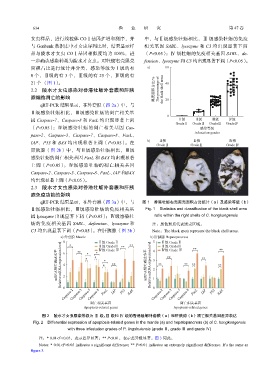
              面积占比进行统计并分类,感染等级为Ⅰ级的有                             a)      60
              0  个,Ⅱ级的有      3  个,Ⅲ级的有     25  个,Ⅳ级的有
              21  个 (图  1) 。                                            40
               2.2 陵水才女虫感染对香港牡蛎外套膜和肝胰                              黑壳面积占比/%  The percentage of  the black shell areas
              腺细胞凋亡的影响                                                  20

                  qRT-PCR  结果显示,在外套膜(图           2a)中,与
              Ⅱ级感染牡蛎相比,Ⅲ级感染牡蛎的凋亡相关基
                                                                        0
              因  Caspase-7、Caspase-8  和  FasL  均出现显著上调                       Ⅰ级     Ⅱ级     Ⅲ级      Ⅳ级
                                                                            GradeⅠ  GradeⅡ  GradeⅢ  GradeⅣ
              (P<0.05) ;Ⅳ级感染牡蛎的凋亡相关基因                  Cas-                           感染等级
                                                                                    Infestation grades
              pase-2、Caspase-3、Caspase-7、Caspase-8、FasL、
              IAP、P53  和  BAX  均出现显著上调(P<0.05) 。在               b)   Ⅱ级            Ⅲ级              Ⅳ级
                                                                    GradeⅡ        GradeⅢ          Grade Ⅳ
              肝胰腺(图      2b)中,与Ⅱ级感染牡蛎相比,Ⅲ级
              感染牡蛎的凋亡相关基因            FasL 和  BAX  均出现显著
              上调(P≤0.05) ;Ⅳ级感染牡蛎的凋亡相关基因

              Caspase-2、Caspase-3、Caspase-8、FasL、IAP  和  BAX
              均出现显著上调(P<0.05) 。
               2.3 陵水才女虫感染对香港牡蛎外套膜和肝胰
              腺免疫功能的影响
                  qRT-PCR  结果显示,在外套膜(图           3a)中,与       图 1    香港牡蛎右壳黑壳面积占比统计(a)及感染等级(b)
              Ⅱ级感染牡蛎相比,Ⅲ级感染牡蛎的免疫相关基                            Fig. 1    Statistics and classification of the black shell area
              因  lysozyme 出现显著下调(P<0.05) ;Ⅳ级感染牡                    ratio within the right shells of C. hongkongensis
              蛎的免疫相关基因          SABL、defension、lysozyme 和         注:黑色斑点代表黑壳区域。
              C3  均出现显著下调(P<0.05) 。在肝胰腺(图              3b)        Note:The black spots represent the black shell areas.

                           a) 外套膜 Mantle                         b) 肝胰腺 Hepatopancreas
                            8 6  *  **    *  Ⅱ级 GradeⅡ  **  **    5 4  Ⅱ级 GradeⅡ   **          **
                                           Ⅲ级 GradeⅢ
                                                                      Ⅲ级 GradeⅢ
                                           Ⅳ级 Grade Ⅳ
                                                                      Ⅳ级 Grade Ⅳ
                         mRNA相对表达水平 Relative mRNA expression level  4 2  * *  *  * *  **  mRNA相对表达水平 Relative mRNA expression level  3 2 1  **  **  **  **  **  **


                            0
                                                                  0
                            Caspase-2 Caspase-3 Caspase-7 Caspase-8  FasL  IAP  P53  BAX  Caspase-2 Caspase-3 Caspase-7 Caspase-8  FasL  IAP  P53  BAX
                                        凋亡相关基因                                凋亡相关基因
                                     Apoptosis-related genes               Apoptosis-related genes
                   图 2    陵水才女虫感染等级为 Ⅱ 级、Ⅲ 级和 Ⅳ 级的香港牡蛎外套膜(a)和肝胰腺(b)凋亡相关基因差异表达
               Fig. 2    Differential expression of apoptosis-related genes in the mantle (a) and hepatopancreas (b) of C. hongkongensis
                              with three infestation grades of P. lingshuiensis (grade Ⅱ, grade Ⅲ and grade Ⅳ)
                  注:* 0.01<P<0.05,表示差异显著;** P<0.01,表示差异极显著。图         3  同此。
                  Notes: * 0.01<P<0.05 indicates a significant difference; ** P<0.01 indicates an extremely significant difference. It’s the same as
              figure 3.

