


Page 279 - 《软件学报》2026年第7期
P. 279
2964                                                       软件学报  2026  年第  37  卷第  7  期


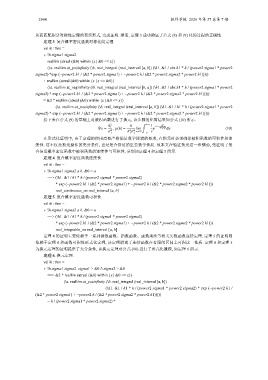
                 从而匹配积分对称性定理的表示形式, 完成证明. 继而, 定理                3  成功验证了公式    (8) 和  (9) 化简过程的正确性.
                    定理  3. 复合概率密度函数对称化简定理.
                    val it : thm =
                      ⊢ !h sigma1 sigma2.
                     reallim (atreal (&0) within {x | &0 <= x})
                     (\a. reallim at_posinfinity (\b. real_integral (real_interval [a, b]) (\h1. &1 / abs h1 * h / (power2 sigma1 * power2
                 sigma2) *exp (--power2 h1 / (&2 * power2 sigma1) + --power2 h / (&2 * power2 sigma2 * power2 h1)))))
                    + reallim (atreal (&0) within {x | x <= &0})
                     (\a. reallim at_neginfinity (\b. real_integral (real_interval [b, a]) (\h1. &1 / abs h1 * h / (power2 sigma1 * power2
                 sigma2) * exp (--power2 h1 / (&2 * power2 sigma1) + --power2 h / (&2 * power2 sigma2 * power2 h1)))))
                    = &2 * reallim (atreal (&0) within {x | &0 <= x})
                       (\a. reallim at_posinfinity (\b. real_integral (real_interval [a, b]) (\h1. &1 / h1 * h / (power2 sigma1 * power2
                 sigma2) * exp (--power2 h1 / (&2 * power2 sigma1) + --power2 h / (&2 * power2 sigma2 * power2 h1)))))
                    接下来在公式      (9) 的基础上对被积函数进行了换元, 该步骤的化简结果如公式                 (10) 所示.

                                                 h 2       h    ∫  +∞  1 −v−  h 2
                                                                         1 2 dv
                                            令v =  1  , p(h) =  lim   e  4σ 2 σ 2 v                   (10)
                                                            2
                                                 σ 2     σ σ x→0 +  x v
                                                           2
                                                  1        1  2
                    在形式化证明中, 由于定理的使用需要严格满足数学逻辑的要求, 在换元时必须确保被积函数的可积性和连
                 续性. 这不仅是换元操作的充分条件, 也是复合信道的重要数学性质. 故本文在验证换元这一步骤前, 先证明了复
                 合信道概率密度函数中被积函数的连续性与可积性, 分别如定理                     4  和定理  5  所示.
                    定理  4. 复合概率密度函数连续性.
                    val it : thm =
                      ⊢ !h sigma1 sigma2 a b. &0 < a
                     ==> (\h1. &1 / h1 * h / (power2 sigma1 * power2 sigma2)
                       * exp (--power2 h1 / (&2 * power2 sigma1) + --power2 h / (&2 * power2 sigma2 * power2 h1)))
                       real_continuous_on real_interval [a, b]
                    定理  5. 复合概率密度函数可积性.
                    val it : thm =
                      ⊢ !h sigma1 sigma2 a b. &0 < a
                     ==> (\h1. &1 / h1 * h / (power2 sigma1 * power2 sigma2)
                       * exp (--power2 h1 / (&2 * power2 sigma1) + --power2 h / (&2 * power2 sigma2 * power2 h1)))
                       real_integrable_on real_interval [a, b]
                    定理  4  的证明主要依赖于一系列倒数函数、指数函数、函数乘法等相关实数函数连续定理. 定理                             5  的证明则
                 依赖于定理    4  和函数可积性形式化定理, 该定理描述了连续函数在有限闭区间上可积这一性质. 定理                           4  和定理  5
                 为换元定理的证明提供了充分条件, 该换元定理对公式                 (10) 进行了形式化建模, 如定理       6  所示.
                    定理  6. 换元定理.
                    val it : thm =
                      ⊢ !h sigma1 sigma2. sigma1 > &0 /\ sigma2 > &0
                     ==> &2 * reallim (atreal (&0) within {x | &0 <= x})
                         (\a. reallim at_posinfinity (\b. real_integral (real_interval [a, b])
                                   (\h1. &1 / h1 * h / (power2 sigma1 * power2 sigma2) * exp (--power2 h1 /
                 (&2 * power2 sigma1) + --power2 h / (&2 * power2 sigma2 * power2 h1)))))
                     = h / (power2 sigma1 * power2 sigma2) *

