


Page 266 - 《软件学报》2026年第6期
P. 266
薛大暄 等: 基于差分隐私的通信高效联邦推荐方法                                                        2585


                 Existing  federated  recommendation  algorithms  place  the  model  training  process  in  a  distributed  environment,  effectively  avoiding  the
                 centralized  storage  of  sensitive  user  data  on  a  single  server.  However,  these  approaches  still  face  challenges  related  to  privacy  leakage  and
                 high  communication  costs.  To  address  these  issues,  this  study  proposes  a  communication-efficient  federated  recommendation  algorithm
                 based  on  differential  privacy.  The  algorithm  introduces  a  general  sub-model  selection  strategy  that  strengthens  privacy  protection  of  user
                 interaction  data  on  the  client  side  through  a  randomized  response  mechanism.  On  the  server  side,  it  employs  maximum  likelihood
                 estimation  to  infer  the  true  interaction  frequencies  of  items  and  optimize  the  sub-model  selection  process.  This  strategy  achieves  an
                 effective  balance  between  privacy  protection  and  model  utility.  The  proposed  algorithm  is  applicable  not  only  to  matrix  factorization-based
                 recommendation  models  but  also  to  deep  learning-based  models,  demonstrating  high  flexibility  and  adaptability  across  various
                 recommendation scenarios. Furthermore, to reduce communication overhead, a global model partitioning strategy is proposed to address the
                 complex  structures  and  large  parameter  sizes  of  deep  learning  models.  Differentiated  optimization  strategies  are  applied  to  shallow  and
                 deep  networks  to  effectively  mitigate  communication  costs.  Theoretical  analysis  shows  that  the  method  satisfies  differential  privacy,  while
                 experimental  results  on  real-world  datasets  demonstrate  that  the  proposed  approach  preserves  user  data  privacy  without  significantly
                 compromising model utility, while substantially improving communication efficiency in federated recommendation systems.
                 Key words:  federated recommendation; differential privacy (DP); randomized response; deep learning

                  1   引 言

                    随着数字技术的迅速发展, 推荐系统作为应对信息过载问题、提升用户体验和决策效率的关键技术得到了广
                 泛应用  [1] . 通过对用户历史行为、偏好特征及其上下文信息的分析, 推荐系统能够智能地为用户提供个性化的信
                 息或产品推荐, 广泛应用于电子商务           [2] 、社交网络和内容服务等领域. 然而, 推荐系统的高效运作高度依赖于对用
                 户个人数据的深入挖掘, 包括用户的基本属性、社交网络关系和行为数据等敏感信息. 这种对数据的依赖在提高
                 推荐准确性的同时, 也带来了显著的隐私泄露风险. 例如, 某些攻击者可能通过分析用户的推荐记录, 推测出该用
                 户的敏感行为或偏好, 甚至暴露出用户的身份信息, 从而导致隐私数据被滥用的严重后果. 这一隐私风险揭示了传
                 统中心化数据收集与处理模式的安全隐患               [3,4] . 联邦学习作为一种保护用户隐私的分布式框架被引入推荐系统领
                 域  [5−9] , 允许多个数据持有者在不直接共享用户数据的前提下, 通过在用户设备上本地训练模型, 并交换模型中间
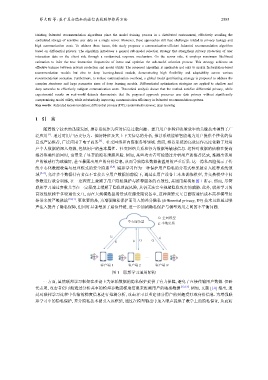
                 参数进行联合训练, 在一定程度上兼顾了用户隐私保护与推荐服务的有效性, 其通用架构如图                              1  所示. 然而, 尽管
                 联邦学习通过参数共享在一定程度上缓解了隐私泄露风险, 其仍无法完全规避隐私攻击的威胁. 此外, 联邦学习的
                 高效性依赖于多轮通信交互, 而在大规模数据场景或资源受限设备中, 这种频繁交互已面临通信成本高和模型复
                 杂带来的严峻挑战      [10,11] . 更重要的是, 为增强隐私保护而引入的差分隐私          (differential privacy, DP) 技术虽然通过噪
                 声注入提升了隐私保障, 但同时显著增加了通信开销, 进一步加剧隐私保护与模型效用之间的不平衡问题.

                                                                       G: 全局模型
                                                          中心服务器        g: 本地更新


                                                  G                     g
                                                    g       g  G    G


                                                                  …
                                              客户端 1       客户端 2       客户端 N
                                                   图 1 联邦学习通用架构

                    一方面, 虽然联邦学习框架在理论上为原始数据的隐私保护提供了有力保障, 避免了直接传输用户数据. 但研
                 究表明, 攻击者仍可能通过分析共享的模型参数或梯度信息来推测用户的敏感数据                           [12,13] . 例如, 文献  [14] 指出, 通
                 过对联邦学习过程中传输的梯度信息进行推测分析, 攻击者可以重建部分用户的兴趣爱好或身份信息. 为增强联
                 邦学习中的隐私保护, 差分隐私技术被引入该框架, 通过在模型输出中加入噪声提供了数学上的隐私保证, 从而防

