


Page 164 - 《爆炸与冲击》2026年第6期
P. 164
第 46 卷               陈安然,等: 高速破片撞击燃油箱导致的燃油喷溅特性                                  第 6 期

               model of the distribution of fuel spurt was established. According to the cracks at the penetration orifices and the shape change

               of the material at the edge of the orifices, the value of the coefficient of discharge was classified, and the influence of the
               distribution of pressure in the fuel was also taken into account during the calculation. When v ≤737 m/s, the range of C  is
                                                                                    0
                                                                                                        v
               from 0.60 to 0.70. When 737 m/s<v <906 m/s, C  ranges from 0.25 to 0.55. When v ≥906 m/s, C  ranges from 0.75 to 0.95.
                                         0          v                        0         v
               The research showed that the average error between the calculation results of the fuel spurt axial distance and the experimental
               results was less than 15%. The error between the calculation results of the corrected theoretical model of radial distance and the
               experimental  results  was  about  5%.  The  calculated  results  of  the  theoretical  model  were  in  good  agreement  with  the
               experimental results.
               Keywords:  high-velocity impact; fuel tank; hydrodynamic ram; fuel spurt

                   燃油箱等贮油容器是飞机、车辆等高价值运动目标的必备、易损部件,当高速侵彻体(战斗部破片、
               子弹、穿甲弹等)撞击/侵彻燃油箱时,侵彻体将能量传递给油液,从而产生作用于箱体壁面的压力载荷,
               即发生液压水锤效应,该过程会导致箱体变形甚至破坏。燃油箱内压力场驱动油液从侵彻孔或箱体裂
               缝喷出,当喷出的雾化燃油遇到周围点火源(撞击火光、燃烧混合物、热壁、电火花等)时,可能引发火灾
               甚至爆炸,进而影响此类目标的生存能力。
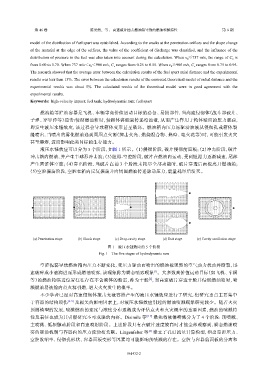
                   液压水锤效应可以分为           5  个阶段,如图     1  所示。(1)侵彻阶段,破片侵彻前面板;(2)冲击阶段,破片
               冲击箱内燃油,并产生半球形冲击波;(3)阻滞-空腔阶段,破片在燃油内运动,受到阻滞力逐渐减速,尾部
               产生圆锥体空腔;(4)穿出阶段,当破片在前                  3  个阶段未耗尽全部动能时,破片穿透后面板离开燃油箱;
               (5)空腔振荡阶段,空腔在箱内反复振荡并向周围燃油传递脉动压力,能量耗尽后溃灭。


                (a) Penetration stage  (b) Shock stage  (c) Drag-cavity stage  (d) Exit stage  (e) Cavity oscillation stage

                                                 图 1    液压水锤效应的   5  个阶段
                                             Fig. 1    The five stages of hydrodynamic ram

                   空腔振荡导致燃油箱内压力不断变化,受压力驱动而喷出的燃油被强烈的空气动力扰动并撕裂,迅
                                                                     [1]
               速破碎成小油滴进而形成燃油喷雾,该现象称为瞬态喷雾现象 。大多数高价值运动目标(如飞机、车辆
                                                                   [2]
               等)的燃油箱临近位置往往存在不含液体的舱室,称为干舱 ,当高速破片穿透干舱并侵彻燃油箱时,喷
               溅燃油易被舱内点火源引燃,增大火灾发生的概率。
                   不少学者已经对高速侵彻体撞击充液容器产生的液压水锤效应进行了研究,但研究重点主要集中
               于容器的结构毁伤        [3-5]  及相关的影响因素上,对液压水锤效应引起的燃油喷溅现象研究较少。随着火灾
               预测模型的发展,喷溅燃油的速度与浓度分布逐渐成为评估点火和火灾概率的重要因素,燃油的喷溅特
               性及表征也成为其引燃研究不可或缺的内容。Disimile 等                     [6-7]  最先将液体喷溅分为了        4  个阶段:预喷溅、
               主喷溅、低频脉动阶段和高速喷射阶段。上述阶段只有在破片速度较高时才能全部观察到,瞬态燃油喷
               雾的驱动机制与容器内的压力波动相关联。Lingenfelter 等                   [8]  建立了孔口流量计算模型,指出空腔压力、
               空腔收缩率、侵彻孔形状、容器面板变形等因素均可能影响预喷溅的存在。空腔与容器前面板的分离和


                                                         061432-2

