


Page 192 - 《爆炸与冲击》2026年第5期
P. 192
第 46 卷     韩思豪,等: 机器学习驱动的折纸超材料夹芯结构低速冲击响应预测及多目标优化                                第 5 期

                                                                  20                                 25

                                        Nadir point Θ 8                                     Simulated
                  0.255                                           16                        Predicted  20
                 Effective density  0.250                        Force/kN  12 8              α=22.4°  15  Internal energy/J

                                                                                             β=25.2°
                                                                                                     10
                                                                                             θ=29.9°
                  0.245 Nadir
                       point  Knee point Θ 9                      4                    F P =17.72 kN  5
                                                                                       ρ eff =0.256 4
                       Θ 10
                  0.240                                                                              0
                       15         16        17 Utopia point 18    0       1     2      3      4     5
                                   Force/kN                                      Time/ms
                         (a) Pareto front and the key points             (b) Impact responses of Θ 8
                    20                                  25        16                                 25
                                              Simulated                                     Simulated
                    16                        Predicted  20                                 Predicted  20
                                                                  12                     F P =14.97 kN
                                                                                         ρ eff =0.240 4
                   Force/kN  12 8              α=20.9°  15  Internal energy/J  Force/kN  8     α=17.3°  15  Internal energy/J
                                               β=25.5°
                                                                                               β=27.6°
                                                        10
                                                                                                     10
                                               θ=29.6°
                                          F P =16.58 kN           4                            θ=26.6°
                     4                    ρ eff =0.244 3  5                                          5
                                                        0                                            0
                     0      1      2     3      4      5          0       1     2      3      4     5
                                   Time/ms                                       Time/ms
                            (c) Impact responses of Θ 9                  (d) Impact responses of Θ 10
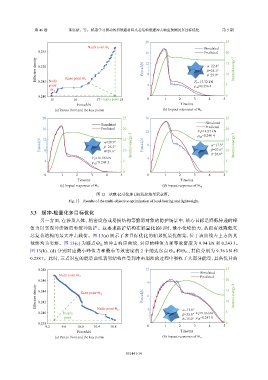
                                            图 12    承载-轻量化多目标优化结果示意图。
                                Fig. 12    Results of the multi-objective optimization of load-bearing and lightweight.

                3.3    缓冲-轻量化多目标优化
                   另一方面,在涉及人体、精密设备或易损结构等脆弱对象的防护场景中,核心目标是降低传递的峰
               值力以实现冲击隔离和缓冲防护。这要求防护结构在轻量化的同时,最小化峰值力,从而有效降低夹

               芯复合结构的最大冲击载荷。图                13(a) 展示了多目标优化的帕累托最优解集,位于该曲线左上方的其
               他解均为劣解。图         13(c) 为膝点   Θ 12  的冲击响应曲线,对应的峰值力和等效密度为                   9.94 kN  和  0.243 3。
               图  13(b)、(d) 分别对应最小峰值力和最小等效密度的                   2  个纳达尔点    Θ 11  和   Θ 13  ,其值分别为  9.36 kN  和
               0.238 7。此时,三者对应的能量曲线表明结构在受到冲击塌溃的过程中吸收了大部分能量,具备优异的


                  0.248                                           12                                 25
                                                                                          Simulated
                           Nadir point Θ 11
                                                                                          Predicted
                  0.246                                                                              20
                                                                  9
                 Effective density  0.244  Knee point Θ 12       Force/kN  6                         15  Internal energy/J
                                                                                                     10
                  0.242
                  0.240      Utopia         Nadir point Θ 13      3               α=15.0°  F P =9.36 kN  5
                                                                                  β=35.0°
                             point                                                θ=15.0°  ρ eff =0.247 0
                  0.238                                                                              0
                     9.2    9.6    10.0    10.4   10.8            0       1     2      3      4     5
                                   Force/kN                                      Time/ms
                         (a) Pareto front and the key points             (b) Impact responses of Θ 11


                                                         051441-14


                                     α                                           α
                                     β                                           β
                                     θ     ρ                                     θ      ρ


                                           Θ                                             Θ

