


Page 126 - 《爆炸与冲击》2026年第4期
P. 126
第 46 卷                    王千惠,等: 负泊松比防爆墙抗爆性分析                                   第 4 期

                                 Effective plastic strain     Effective plastic strain     Effective plastic strain

                                       2.00                          2.00                         2.00
                                       1.67                          1.67                         1.67
                                       1.33                          1.33                         1.33
                                       1.00                          1.00                         1.00
                                       0.67                          0.67                         0.67
                                       0.33                          0.33                         0.33
                                       0                             0                            0


                          (a) C-N slab                  (b) C-P slab                 (c) C-S slab

                                           图 16    混凝土组  3  种结构靶板迎爆面损伤云图
                                  Fig. 16    Damage cloud diagram of explosion-facing surface of concrete group
                                Effective plastic strain      Effective plastic strain     Effective plastic strain

                                       2.00                          2.00                         2.00
                                       1.67                          1.67                         1.67
                                       1.33                          1.33                         1.33
                                       1.00                          1.00                         1.00
                                       0.67                          0.67                         0.67
                                       0.33                          0.33                         0.33
                                       0                             0                            0


                          (a) U-N slab                 (b) U-P slab                  (c) U-S slab

                                           图 17    UHTCC  组  3  种结构靶板迎爆面损伤云图
                                   Fig. 17    Damage contours of the explosion-facing surface of UHTCC slabs
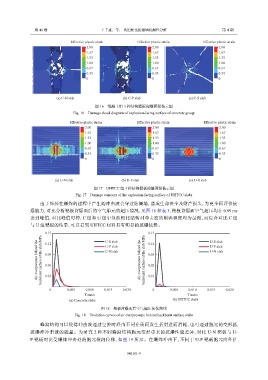
                   由于炸药在爆炸的过程中产生的冲击波会穿过防爆墙,造成生命安全及财产损失,为更全面评价抗
               爆能力,对比分析靶板背爆面后的空气单元的超压情况,见图                          18 和表  3,靶板背爆面空气超压均在            0.99 ms
               达到峰值,对比峰值可得,C            组和  U  组中负泊松比结构对冲击波的削弱程度均为最强,而综合对比                             C  组
               与  U  组靶板的结果,可以看到         UHTCC  材料具有明显的抗爆优势。
                     0.15                       C-S slab           0.15                       U-S slab

                 Air overpressure behind the backburst surface of the slab/MPa  0.09  C-N slab  Air overpressure behind the backburst surface of the slab/MPa  0.03  U-P slab
                                                                   0.14
                     0.12
                                                C-P slab
                                                                                              U-N slab

                     0.06
                                                                   0.02
                     0.03


                       0       0.005   0.010   0.015    0.020      0.01 0    0.005   0.010   0.015   0.020
                                       Time/s                                       Time/s
                                (a) Concrete slabs                            (b) UHTCC slabs

                                              图 18    靶板背爆面后空气超压演化曲线
                                  Fig. 18    Evolution curves of air overpressure behind backburst surface slabs
                   蜂窝结构可以使得冲击波通过空腔时经由不同介质面发生折射进而消耗,也可通过胞元的变形抵
               抗爆炸冲击波的能量。为研究               2  种不同蜂窝结构胞元变形带来的抗爆性能差异,对比                        U-N  靶板与   U-

               P  靶板对比受爆炸冲击处的胞元横向位移,如图                    19  所示。在爆炸冲击下,不同于             U-P  靶板胞元向外扩


                                                         045101-9

