


Page 183 - 《爆炸与冲击》2026年第3期
P. 183
第 46 卷              曾启富,等: 多孔冲击下超临界CO 2 相变破岩半径计算模型                              第 3 期

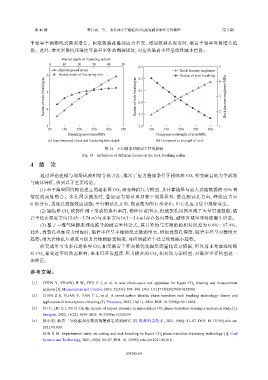
               半径呈半抛物线式微弱增长。固定致裂孔叠加应力不变、增加致裂孔深度时,破岩半径呈对数增大趋
               势。此外,增大岩体抗压强度可提升岩体的断裂韧度,对应的破岩半径呈线性减小趋势。


                             Buried depth of fracturing tube/m
                       0     10    20     30    40     50
                                                              4.5                                 5
                           Superimposed stress                                   Rock fracture toughness
                           Buried depth of fracturing tube
                      6                                       4.3                Radius of rock breaking  4
                     Radius of rock breaking/m  5 4          Radius of rock breaking/m  4.1       3 2 Rock fracture toughness/MPa


                                                              3.9


                                                              3.5
                      3                                       3.7                                 1
                      50    150    250    350   450    550         100    150   200    250   300
                               Superimposed stress/MPa                Compressive strength of rock/MPa
                      (a) Superimposed stress and fracturing tube depth  (b) Compressive strength of rock
                                                图 14    不同因素对破岩半径的影响
                                      Fig. 14    Influences of different factors on the rock breaking radius
                4    结 论

                   通过理论建模与现场试验相结合的方法,揭示了应力叠加条件下超临界                                  CO 相变破岩的力学机制
                                                                                      2
               与破坏特征,得到以下主要结论。
                   (1) 基于薄壁圆筒理论建立的超临界              CO 相变峰值压力模型,其计算结果与前人试验数据的                        95%  置
                                                      2
               信区间高度吻合。多孔同步激发时,叠加应力场呈现显著空间异质性:垂直测试孔方向,峰值应力呈
               U  形分布,边缘孔叠加效应最强;平行测试孔方向,则表现为倒                         U  形分布,中心孔应力集中现象突出。
                   (2) 超临界  CO 致裂作用下形成的块石率高,粉碎区范围小,但致裂孔周围出现了大量贯通裂隙;破
                               2
               岩半径在深度方向(5.05~5.74 m)与水平方向(4.3~5.6 m)存在各向异性,破坏区域呈非对称漏斗形态。
                   (3) 基于一维气体膨胀理论推导的破岩半径公式,其计算值与实测值的相对误差为                                     0.9%~17.4%。
               此外,致裂孔叠加应力增加时,破岩半径呈半抛物线式微弱增大;增加致裂孔深度,破岩半径呈对数增大
               趋势;增大岩体抗压强度可提升岩体的断裂韧度,对应的破岩半径呈线性减小趋势。
                   研究成果可为多孔超临界            CO 相变破岩工程参数优化提供定量化设计依据,但目前未考虑温度场
                                             2
               对  CO 相变速率的动态影响,未来可开发温度-压力耦合的                        CO 相变动力学模型,对破岩半径模型进一
                    2
                                                                       2
               步修正。

               参考文献:
               [1]   CHEN  Y,  ZHANG  H  W,  ZHU  Z  J,  et  al.  A  new  shock-wave  test  apparatus  for  liquid  CO 2   blasting  and  measurement
                    analysis [J]. Measurement and Control, 2019, 52(5/6): 399–408. DOI: 10.1177/0020294019838581.
               [2]   CHEN  Z  S,  YUAN  Y,  YAN  C  L,  et  al.  A  novel  carbon  dioxide  phase  transition  rock  breaking  technology:  theory  and
                    application of non-explosive blasting [J]. Processes, 2022, 10(11): 2434. DOI: 10.3390/pr10112434.
               [3]   PU C, LIU Z J, PU G. On the factors of impact pressure in supercritical CO 2  phase-transition blasting-a numerical study [J].
                    Energies, 2022, 15(22): 8599. DOI: 10.3390/en15228599.
               [4]   孙小明. 液态二氧化碳相变致裂掏槽破岩试验研究 [J]. 煤炭科学技术, 2021, 49(8): 81–87. DOI: 10.13199/j.cnki.cst.
                    2021.08.010.
                    SUN X M. Experimental study on cutting and rock breaking by liquid CO 2  phase transition fracturing technology [J]. Coal
                    Science and Technology, 2021, 49(8): 81–87. DOI: 10.13199/j.cnki.cst.2021.08.010.


                                                         034201-14

