


Page 9 - 《软件学报》2026年第5期
P. 9
1888                                                       软件学报  2026  年第  37  卷第  5  期


                 Abstract:  Symbolic music understanding (SMU) is a crucial task in multimedia content understanding, aiming to extract multi-dimensional
                 musical  attributes  such  as  melody,  dynamics,  compositional  style,  emotion,  and  genre  from  symbolic  representations.  Although  existing
                 approaches  have  substantially  advanced  dependency  modeling  in  musical  sequences,  two  critical  challenges  remain:  (1)  Simplified
                 representation: Current methods typically flatten complex musical structures into linear symbolic sequences, overlooking the inherent multi-
                 dimensional  hierarchical  information;  (2)  Lack  of  music-theory  integration:  Purely  data-driven  sequence  models  struggle  to  incorporate
                 structured  music-theory  knowledge,  limiting  deep  semantic  understanding  of  music.  To  address  these  issues,  this  study  proposes  CNN-
                 Midiformer,  a  high-precision  symbolic  music  understanding  model  that  integrates  structured  representations  of  musical  knowledge.  First,
                 the  model  constructs  structured  representations  for  music  theory  and  musical  sequences  based  on  domain  knowledge.  Second,  a
                 complementary  music-feature  extraction  module  is  devised  to  employ  convolutional  neural  networks  (CNN)  for  capturing  deep  local
                 features  from  structured  musical-knowledge  representations,  while  a  Transformer  encoder  with  self-attention  captures  deep  semantic
                 features  from  musical  sequences.  Finally,  a  music-knowledge  adaptive-enhancement  feature-fusion  module  dynamically  integrates  the  deep
                 musical-knowledge  features  extracted  by  CNN  with  the  deep  semantic  features  of  the  Transformer  via  an  efficient  cross-attention
                 mechanism,  thus  enhancing  contextual  sequence  understanding  and  representation  learning.  Comparative  experiments  conducted  on  six
                 public symbolic-music datasets (Pop1K7, ASAP, POP909, Pianist8, EMOPIA, and ADL) demonstrate that CNN-Midiformer surpasses state-
                 of-the-art  methods  across  five  benchmark  downstream  tasks:  melody  recognition,  dynamics  prediction,  composer  classification,  emotion
                 classification, and genre classification, achieving a precision gain of 0.21–7.14 percentage points over baseline models.
                 Key words:  symbolic  music  understanding  (SMU);  structured  representation  of  music  knowledge;  convolutional  neural  network  (CNN);
                         Transformer; feature fusion

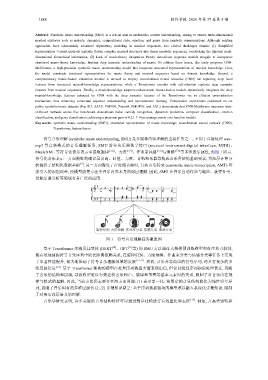
                    符号音乐理解      (symbolic music understanding, SMU) 是多媒体内容理解的重要任务之一, 不同于直接处理        wav、
                 mp3  等音频格式的音乐理解任务, SMU          旨在从乐器数字接口         (musical instrument digital interface, MIDI)、
                 MusicXML  等符号化音乐表示中提取旋律          [1,2] 、力度  [3,4] 、作曲家风格  [5,6] 与情感  [7,8] 等多维音乐属性, 如图  1  所示.
                 符号化音乐表示一方面能够精确记录音高、时值、力度、音轨和乐器等构成音乐骨架的基础要素, 为深层计算分
                 析提供了结构化数据基础         [9] ; 另一方面避免了在处理音频时, 自动音乐转录           (automatic music transcription, AMT) 可
                 能引入的识别误差, 使模型能更专注于音乐内容本身的深层理解. 因此, SMU                     在音乐自动作曲与编曲、旋律补全、
                 智能乐谱分析等领域有着广泛的应用.


                                            旋律识别 力度预测 作曲家分类 情感分类 流派分类

                                                图 1 符号音乐理解任务概览图

                    基于  Transformer 架构及其变体   (BERT [10] 、GPT [11] 等) 的  SMU  方法通过大规模预训练模型和自注意力机制,
                 能有效地捕捉符号音乐序列中的长距离依赖关系, 在旋律识别、力度预测、作曲家分类与情感分类等任务上实现
                 了显著性能提升, 极大地推动了符号音乐理解领域的发展                   [12,13] . 然而, 音乐并非简单的符号序列, 还具有复杂的多
                 维层级信息    [14] . 基于  Transformer 架构的模型在处理序列数据方面表现出色, 但仅以线性序列视角处理音乐, 忽略
                 了音乐的结构和层级, 导致模型难以有效建模音乐和声、旋律和节奏等基本元素间的关系, 限制了对音乐内在规
                 律与模式的理解. 因此, 当前方法仍主要存在两方面问题: (1) 表示单一化: 将复杂的音乐结构简化为线性符号序
                 列, 忽略了音乐固有的多维层级信息; (2) 乐理知识缺乏: 基于序列数据驱动的模型难以融入系统化乐理知识, 限制
                 了对音乐深层语义的理解.
                    音乐学研究表明, 许多关键的音乐结构特征可以通过数学建模进行有效量化和表征                             [15] . 例如, 音高类别转移

