


Page 52 - 《软件学报》2026年第4期
P. 52
骆祥峰 等: 基于强-弱互信息掩码学习的可解释动态不完整图异常检测                                               1493


                 strong-weak  mutual  information  (SWMI)  loss,  it  captures  the  relationship  between  structure  and  features  while  maintaining  structural
                 integrity,  reducing  overfitting,  and  improving  generalization.  Furthermore,  EXDIG  enhances  the  interpretability  of  anomaly  detection  in
                 DIGs  by  incorporating  masked  perturbations  on  nodes,  edges,  and  features,  enabling  the  identification  of  key  components  and  providing
                 transparent,  trustworthy  explanations  for  anomaly  detection  results.  This  study  evaluates  EXDIG  on  nine  real-world  graph  datasets,  and  the
                 results  demonstrate  its  superiority  over  state-of-the-art  methods  across  different  levels  of  DIG  scenarios  and  across  various  downstream
                 tasks  and  representation  learning  evaluations,  both  supervised  and  unsupervised.  Specifically,  on  the  Amazon  anomaly  detection  dataset,
                 EXDIG  achieves  improvements  over  13%  and  15%  in  NMI  and  ARI,  respectively.  It  maintains  F1-score  fluctuations  within  5%  across
                 dynamic incompleteness ratios from 25% to 99%. Notably, EXDIG enables node-level interpretability in dynamic incomplete graphs.
                 Key words:  explainable graph learning; masked autoencoder; mutual information; graph anomaly detection

                    图异常检测     [1−3] 是一种用于识别图中异常节点的技术, 广泛应用于社交媒体垃圾检测、网络安全、欺诈检测、
                 金融风险分析、医疗诊断、推荐系统等多个领域. 因此, 一些研究者将图异常检测转化为节点分类问题, 并利用图
                 神经网络   (graph neural network, GNN) [4−9] 来学习节点的有效表示, 通过聚合多跳邻居信息, 捕捉隐藏模式, 来增强
                 对抗攻击的鲁棒性.
                    然而, 大多数    GNN  方法假设观测到的图数据足够理想, 能够提供充足的信息                    (结构、特征、标签) 用于训
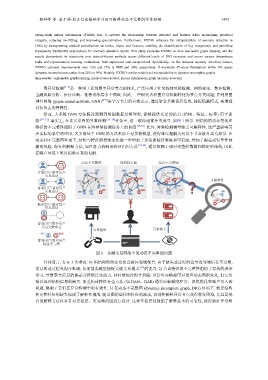
                 练  [10−15] . 事实上, 在真实世界的异常检测   [16−18] 任务中, 这一假设通常并不成立, 如图       1  所示. 图结构的动态变化和
                 特征的不完整性阻碍了        GNN  在图异常检测任务上的训练          [19,20] . 此外, 异常检测模型缺乏可解释性, 这严重影响其
                 在实际场景中的应用. 大多数基于           GNN  的方法本质上是黑箱模型, 使得难以理解为何某个节点被分类为异常. 在
                 动态和不完整图环境下, 结构与特征的持续变化进一步增加了决策的验证难度和可信度, 增加了偏差或误导性预
                 测的风险. 现有的解释方法, 如注意力机制或特征归因方法                  [21,22] , 通常依赖于相对完整的数据和稳定的结构, 因此
                 在噪声环境下难以提供可靠的见解.

                                     动态不完整图           理想状态图            动态不完整图

                  普通用户-欺诈用户
                     交易成功
                                                                                              可解释性

                  普通用户-普通用户
                     交易成功

                  欺诈用户-欺诈用户
                     交易成功


                  普通用户/欺诈用户
                   交易失败中止
                                          交易超时                       异常锁卡

                  普通用户/欺诈用户
                    特征不完整

                                            图 1 金融交易网络中的动态不完整图问题

                    具体而言, 存在     3  大难点: 1) 图结构的动态变化会破坏邻域聚合, 由于缺失或过时的边导致邻域信息不完整,
                 消息传递过程变得不准确, 从而削弱模型捕捉关键关系模式                   [23] 的能力; 2) 节点特征的不完整性阻碍了有效的表示
                 学习, 导致聚合信息的偏差并降低泛化能力, 同时增加过拟合风险. 尽管时序模型可以适应动态图的变化, 但它们
                 难以处理结构信息的缺失. 而重构或特征补全方法                (如  GAN、GAE) 通常面临梯度冲突、次优优化和噪声引入的
                 问题, 限制了它们在异常检测中的有效性; 3) 在动态不完整图                 (dynamic incomplete graph, DIG) 环境下, 稳定结构
                 和完整特征的缺失加剧了解释性挑战. 随着图的演化和特征的波动, 识别和解释异常节点变得愈发困难, 尤其是现
                 有的解释方法往往针对更稳定、更完整的图进行设计. 这种不稳定性削弱了解释技术的可靠性, 使得验证异常检

