


Page 107 - 《软件学报》2025年第10期
P. 107
4504                                                      软件学报  2025  年第  36  卷第  10  期


                         证明生成时间 (s)  20                         验证时间 (ms)  100
                          40   EQAS  SPHINCS+  LVMT             200   EQAS   SPHINCS+  LVMT


                          0
                              500     1 000   1 500   2 000       0  500     1 000   1 500   2 000
                                        查询次数                                    查询次数
                                (a) 不同查询数量下证明生成时间                        (b) 不同查询数量下验证时间
                                                  EQAS  SPHINCS+  LVMT
                                            总时间 (s)  20


                                              0
                                                 500    1 000    1 500   2 000
                                                           查询次数
                                                    (c) 不同查询数量下总时间开销
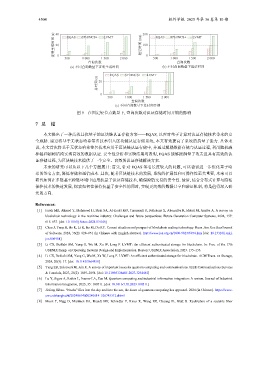
                                   图 9 在固定轻节点数量下, 查询次数对认证存储时间开销的影响

                  7   总 结

                    本文提出了一种高效且抗量子的区块链认证存储方案——EQAS, 以应对量子计算对认证存储技术带来的安
                 全威胁. 通过将基于无状态哈希签名技术引入区块链认证存储系统, 本文有效提高了系统的抗量子能力. 具体来
                 说, 本文首次将基于无状态哈希签名技术应用于区块链认证存储中, 并通过解耦数据存储与认证过程, 利用随机森
                 林链和超树结构实现高效的数据认证. 安全性分析和实验结果均表明, EQAS                       能够抵御量子攻击且具有高效的认
                 证存储过程, 为区块链技术提供了一个安全、高效的认证存储解决方案.
                    未来的研究可以从以下几个方面展开: 首先, 针对               EQAS  签名长度较大的问题, 可以尝试进一步优化基于哈
                 希的签名方案, 降低存储和通信成本. 其次, 随着区块链技术的发展, 系统的扩展性和可操作性至关重要, 未来可以
                 研究如何在多链甚至跨链环境中应用抗量子认证存储技术, 确保跨链交易的安全性. 最后, 结合分布式计算与隐私
                 保护技术的快速发展, 探索如何在保持抗量子安全性的同时, 实现更高效的数据共享和验证机制, 将是值得深入研
                 究的方向.

                 References:
                  [1]   Farah MB, Ahmed Y, Mahmoud H, Shah SA, Al-Kadri MO, Taramonli S, Bellekens X, Abozariba R, Idrissi M, Aneiba A. A survey on
                     blockchain technology in the maritime industry: Challenges and future perspectives. Future Generation Computer Systems, 2024, 157:
                     618–637. [doi: 10.1016/j.future.2024.03.046]
                  [2]   Chen J, Yang H, He K, Li K, Jia M, Du RY. Current situation and prospect of blockchain scaling technology. Ruan Jian Xue Bao/Journal
                     of Software, 2024, 35(2): 828–851 (in Chinese with English abstract). http://www.jos.org.cn/1000-9825/6954.htm [doi: 10.13328/j.cnki.
                     jos.006954]
                  [3]   Li CX, Beillahi SM, Yang G, Wu M, Xu W, Long F. LVMT: An efficient authenticated storage for blockchain. In: Proc. of the 17th
                     USENIX Symp. on Operating Systems Design and Implementation. Boston: USENIX Association, 2023. 135–153.
                  [4]   Li CX, Beillahi SM, Yang G, Wu M, Xu W, Long F. LVMT: An efficient authenticated storage for blockchain. ACM Trans. on Storage,
                     2024, 20(3): 17. [doi: 10.1145/3664818]
                  [5]   Yang ZB, Zolanvari M, Jain R. A survey of important issues in quantum computing and communications. IEEE Communications Surveys
                     & Tutorials, 2023, 25(2): 1059–1094. [doi: 10.1109/COMST.2023.3254481]
                  [6]   Lu Y, Sigov A, Ratkin L, Ivanov LA, Zuo M. Quantum computing and industrial information integration: A review. Journal of Industrial
                     Information Integration, 2023, 35: 100511. [doi: 10.1016/J.JII.2023.100511]
                  [7]   Jiefang Ribao. “Nezha” flies into the sky and into the sea, the dawn of quantum computing has appeared. 2024 (in Chinese). https://www.
                     cnr.cn/shanghai/tt/20240614/t20240614_526745312.shtml
                  [8]   Monz  T,  Nigg  D,  Martinez  EA,  Brandl  MF,  Schindler  P,  Rines  R,  Wang  SX,  Chuang  IL,  Blatt  R.  Realization  of  a  scalable  Shor

