


Page 382 - 《软件学报》2025年第9期
P. 382
王尚 等: 基于神经网络的分布式追踪数据压缩和查询方法                                                     4293


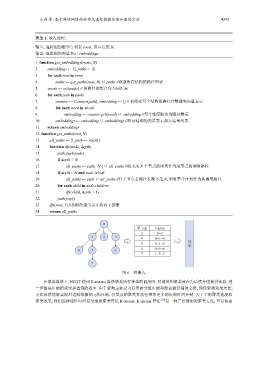
                 算法  1. 嵌入过程.
                 输入: 追踪图的根节点列表        roots, 窗口长度  N;
                 输出: 追踪图的向量表示       embeddings.

                 1. function get_embeddings(roots, N)
                 2.   embeddings ← [], paths ← []
                 3.   for each root in roots
                 4.     paths ← get_paths(root, N) ∪ paths //获取所有结构的路径列表
                 5.   vocab ← set(paths) // 将路径的集合作为词汇表
                 6.   for each path in paths
                 7.     counter ← Counter(path), embedding ← [] // 初始化每个结构的路径计数器和向量表示
                 8.     for each word in vocab
                 9.       embedding ← counter.get(word) ∪ embedding //每个维度取值为路径数量
                 10.      embeddings ← embedding ∪ embeddings //将该结构的向量表示加入结果列表
                 11.    return embeddings
                 12. function get_paths(root, N)
                 13.   all_paths ← [], path ← stack()
                 14.   function dfs(node, depth)
                 15.     path.push(node)
                 16.     if depth ≥ N
                 17.       all_paths ← path[–N:] ∪ all_paths //取末尾  N  个节点的序列作为尾节点的调用路径
                 18.     if depth < N and node is leaf
                 19.       all_paths ← path ∪ all_paths //叶子节点若路径长度不足     N, 则将整个序列作为其调用路径
                 20.     for each child in node.children
                 21.       dfs(child, depth + 1)
                 22.     path.pop()
                 23.   dfs(root, 1) //从树的根节点开始向下搜索
                 24.   return all_paths

                                               0
                                                              尾节点     3-gram
                                                                2      0 2
                                          1    2    3           4     0 1 4
                                                                5     0 1 5          向
                                                                                     量
                                    4     5         6           6     0 3 6
                                                                7     1 5 7
                                          7

                                                       图 6 图嵌入

                    在聚类算法上, NCQT     使用  K-means 算法聚类所有种类的调用图. 对调用图聚类旨在为后续分组提供依据, 进
                 一步提高压缩的效果和查询的效率. 由于聚类主要是为后续的分组压缩和搜索提供辅助支持, 即使聚类效果欠佳,
                 方法依然能够实现对追踪数据的无损压缩, 但复杂的聚类算法会带来更多的压缩时间开销. 为了平衡聚类速度和
                 聚类效果, 我们选择线性时间复杂度的聚类算法               K-means. K-means 算法  [47] 是一种广泛使用的聚类方法, 可以快速

