


Page 89 - 《爆炸与冲击》2026年第6期
P. 89
第 46 卷           卢毓崟,等: 层理倾角与锚固方式耦合作用下砂岩的动态力学特性                                 第 6 期


                                               Core-taking
                                               Surface grinding     30°     15°        0°


                           On-site               Reference       90°      75°       60°     45°
                          sampling               T/CSRME
                            block                001-2019      Ø75 mm×37.5 mm bedding yellow sandstone
                          Anchoring agent               Bolt material                   Drill

                                           Mass ratio of
                                           curing agent to
                                           colloid 1∶2                            4.5 mm
                                           2 h initial curing
                          Curing  Epoxy                    Ø3 mm Q235 screw
                          agent   resin
                                                                                   Open-hole specimen
                                                                            Injecting different doses of
                                              48 h fully anchored                epoxy resin


                                              15% anchorage length  50% anchorage length  95% anchorage length
                                              End-anchor specimens  Semi-anchor specimens  Full-anchor specimens
                            Loadable specimen

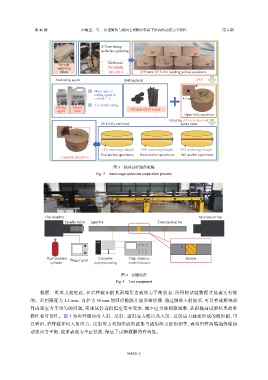
                                                   图 3    锚固试样制备流程
                                            Fig. 3    Anchorage specimen preparation process


                     Gas chamber                                                         Momentum trap
                              Spindle bullet  Input bar                Transmission bar


                                                                                  θ

                      High-pressure  Trigger gear   Computer  High dynamic         Sample
                       cylinder            post-processing  strain indicator


                                                       图 4    试验设备
                                                    Fig. 4    Test equipment
                   根据一维应力波理论,在岩样破坏前其两端要达到应力平衡状态,所得的试验数据才是真实有效
               的。采用厚度为        1.5 mm、直径为    30 mm  的圆形橡胶片波形整形器,通过调整入射波形,可以有效解决试

               件内部应力不均匀的问题,实现试件近似恒应变率变形,减少应力波频散现象,从而提高试验结果的准
               确性和可靠性。图         5  为岩样破坏时入射、反射、透射应力波以及入射、反射应力叠加形成的波形图,可
               以看出,岩样破坏时入射应力、反射应力叠加形成的波形与透射应力近似相等,表明岩样两端始终保持
               动态应力平衡,波形表现为半正弦波,保证了试验数据的有效性。


                                                         061421-5

