


Page 225 - 《爆炸与冲击》2026年第5期
P. 225
第 46 卷                赵春风,等: 基于XGBoost的PC板爆炸损伤评估模型                              第 5 期

                                  True        Precision                 True        Precision

                      7      0     0      0  100.00%        8      0     0      0  100.00%


                      2     10     1      1   71.43%        1      9     0      0   90.00%

                   Predicted  1  0  7     1   77.78%     Predicted  1  1  9     1   75.00%


                      0      0     2      8   80.00%        0      0     1      9   90.00%


                   Recall  70.00%  100.00%  70.00%  80.00%  80.00%  Recall  80.00%  90.00% 90.00% 90.00% 87.50%

                     Minor  Medium Severe  Failure Accuracy  Minor  Medium Severe  Failure Accuracy
                    (a) Simplified model-damage assessment dataset  (b) Simplified model-mixed dataset
                                  True        Precision
                      9     0      0     0   100.00%
                                                                1.00 A cc          Ideal optimal model
                                                                1.0
                                                                0.95               XGBoost classification model
                      1     9      0     0   90.00%             0.90
                                                                0.85            P  Simplified model-mixed dataset
                                                                0.80
                                                       κ
                                                                                   Simplified model-damage
                   Predicted  0  3  10   1   90.91%             0.75               assessment dataset
                                                                0.70
                      0     1      0     9   90.00%


                   Recall  90.00%  90.00%  100.00%  90.00%  92.50%  F 1  (d) Comprehensive comparison of three models
                                                                           R c
                     Minor  Medium Severe  Failure Accuracy
                        (c) XGBoost classification model

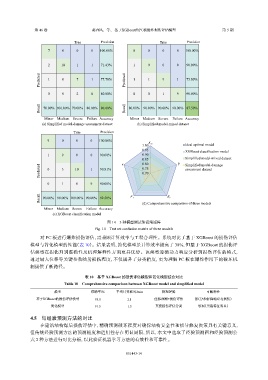
                                                 图 14    3  种模型测试集混淆矩阵
                                           Fig. 14    Test set confusion matrix of three models
                   对  PC  板进行爆炸损伤评估,需兼顾计算效率与工程合理性。系统对比了基于                               XGBoost 的损伤评估
               模型与简化模型的性能(表            10)。结果表明,简化模型虽计算效率提高了                   38%,但基于    XGBoost 的损伤评
               估模型在损伤判别准确性及机理解释性方面更具优势。该模型遵循动力响应分析到损伤评估的模式,
               通过最大位移等关键参数映射损伤程度,不仅提升了分类精度,更为理解                                 PC  板在爆炸作用下的破坏机
               制提供了新路径。


                                       表 10    基于  XGBoost 的损伤评估模型和简化模型综合对比
                             Table 10    Comprehensive comparison between XGBoost model and simplified model
                         模型              准确率/%       平均计算耗时/min          物理逻辑                可解释性
                 基于XGBoost的损伤评估模型          95.0           2.1         位移预测+损伤评估        强(分步解释响应与损伤)
                        简化模型               91.5           1.3         直接损伤评估分类           较弱(黑箱特征明显)

                4.5    与经验预测方法的对比

                   在建筑结构爆后损伤评估中,精确预测破坏程度对确保结构安全性和指导修复决策具有关键意义,
               但传统经验预测方法的预测精度和适用性存在明显局限,所以,本文中选取了经验预测图和经验预测公
               式  2  种方法进行对比分析,以此验证机器学习方法的有效性和可靠性。


                                                         051443-14

