


Page 34 - 《爆炸与冲击》2026年第3期
P. 34
第 46 卷          王    强,等: 间隙C掺杂CoCrNi基中熵合金的应变率效应和温度效应                           第 3 期

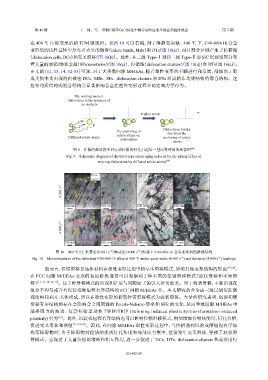
               在  400 ℃ 压缩变形后的      TEM  微观图。从图       10  可以看到,对于准静态加载、400 ℃             下,C48-800-1h  合金
               变形后的试样基体中分布着大量的微带(micro bands, MBs)和                  DTs(图  10(a)),而且部分区域产生了位错胞
               (dislocation cells, DCs)和交叉滑移(图  10(b))。此外,在二级     Type-Ⅰ型和三级      Type-Ⅱ型  SiC  沉淀周围分布
               着大量的层错/纳米孪晶(SFs/nanotwins)(图          10(c))、位错簇(dislocation clusters)(图  10(d))和  DTs(图  10(e))。
               由文献   [11, 13, 14, 52-58] 可知,对于大多数间隙      M/HEAs,随着塑性变形的不断进行和发展,都倾向于形
               成类似本文出现的由致密            DCs、MBs、SFs、dislocation clusters 和  DTs 组成的非均质结构的混合结构。这
               些非均质结构的混合结构会显著影响合金在塑性变形过程中的宏观力学行为。

                                  The waiting motion

                               dislocation in the presence of
                                     an obstacle
                                                                Higher stress


                                                     The anchoring of     Dislocation breaks
                                                                           free from the
                               Diffused solute atoms  solute atoms on    anchoring of solute
                                                      dislocations
                                                                              atoms
                                  图 9    扩散的溶质原子对运动位错的钉扎引起第三型应变时效的示意图                 [49]
                               Fig. 9    Schematic diagram of the third-type strain aging induced by the pining effect of
                                             moving dislocation by diffused solute atoms [49]


                              (a)         Type-Ⅰ (b)          (c)             (d)      Disloaction

                                   MBs    Type-Ⅱ                                        clusters
                            0.001 s −1  DTs      Cross-slip         SFs/nanotwins  DCs      DB

                                                                                 Disloaction
                              400 nm          100 nm DCs      100 nm          200 nm clusters
                              (e)             (f)  1st        (g)             (h)

                            4 000 s −1  DTs Multitwins  MBs  3rd       Dislocation   DCs  Dislocation

                                     Dislocations
                                    SFs/nanotwins  Multitwins           clusters        clusters
                              200 nm          200 nm      2nd 200 nm          50 nm
                                                  −1
                                                              −1
                          图 10    400 ℃  时,准静态(0.001 s )和动态(4 000 s )加载下  C48-800-1h  合金变形后的微观结构
                                                                                                  −1
                                                                                 −1
               Fig. 10    Microstructures of the deformed C48-800-1h alloy at 400 ℃ under quasi-static (0.001 s ) and dynamic (4 000 s ) loadings
                   一般而言,位错滑移是晶体材料在塑性变形过程中的基本滑移模式,影响其他变形结构的形成                                          [59-60] 。
               在  FCC  间隙  M/HEAs 变形的初始阶段通常可以观察到                 2  种不同的位错滑移模式(波状滑移和平面滑
               移) [11, 13, 18, 54, 57] 。这  2  种滑移模式的出现和扩展与间隙原子的引入密切相关。对于波状滑移,主要出现在
               组分不均匀或含有沉淀或硬短程有序结构的                    FCC  间隙  M/HEAs 中。本文研究的合金由三级层级沉淀微
               观结构和    FCC  基体组成,所以在塑性变形的初期位错滑移模式为波状滑移。大量的研究表明,沉淀和硬
               短程有序结构的存在会影响合金周期性的                   Peierls-Nabarro  势垒和  SFE  的变化,从而导致间隙        M/HEAs 中
               晶格阻力的波动、复杂位错运动和                 TWIP/TRIP (twinning induced plasticity/transformation induced
               plasticity) 行为 。此外,沉淀或短程有序结构也可以影响位错滑移模式,例如增加位错核能量,钉扎位错,
                           [61]
               促进交叉滑移和增殖         [11, 62-64] 。因此,在间隙  M/HEAs 塑性变形过程中,当位错遇到沉淀或硬短程有序结
               构等障碍物时,由于障碍物对位错的强烈钉扎作用和局部应力集中,位错发生交叉滑移,导致了波状滑
               移模式。这促进了大量位错的增殖和相互作用,进一步促进了                            DCs、DTs、dislocation clusters 和高密度位


                                                         031402-10

