


Page 253 - 《软件学报》2026年第5期
P. 253
2132                                                       软件学报  2026  年第  37  卷第  5  期


                 4
                 (State Key Laboratory of Computer Science (Institute of Software, Chinese Academy of Sciences), Beijing 100190, China)
                 5
                 (University of Chinese Academy of Sciences, Nanjing, Nanjing 211135, China)
                 Abstract:  With  the  rapid  development  of  large  language  model  (LLM)  technology,  many  Code  LLMs  have  emerged  to  support  tasks  such
                 as  code  generation,  code  completion,  code  testing,  and  code  refactoring.  Different  models  may  show  significant  performance  differences
                 when  processing  the  same  task,  and  the  decoding  parameters  at  the  inference  stage  will  also  have  an  important  influence  on  model
                 performance.  This  study  investigates  how  to  efficiently  select  the  best  model  and  its  optimal  decoding  parameters  for  a  specific  code
                 development  task.  Existing  methods  generally  divide  model  selection  and  parameter  tuning  into  two  independent  stages.  Due  to  the
                 differences  in  sampling  strategies  at  different  stages,  sample  data  cannot  be  shared,  and  the  computational  cost  of  sampling  and  evaluation
                 is  high.  Considering  that  the  decoding  parameter  space  of  different  Code  LLMs  is  the  same,  this  study  proposes  the  utilization  of  the
                 propensity  score  matching  (PSM)  algorithm  for  conducting  weighted  adjustment  and  aligning  sample  data  of  different  distributions  to
                 improve  the  reuse  efficiency  of  sample  data  and  reduce  computational  costs.  Therefore,  this  study  proposes  a  framework  CodeLLMTuner
                 for  Code  LLM  selection  and  decoding  parameter  tuning  based  on  sample  reuse.  The  framework  includes  three  stages,  including  the
                 independent  sampling  stage,  which  performs  decoding  parameter  tuning  (such  as  Bayesian  optimization)  on  multiple  Code  LLMs  in
                 parallel  and  conducts  data  sampling  and  evaluation  to  collect  sample  data.  Additionally,  the  model  selection  stage  adopts  PSM  technology
                 to  align  the  sample  data  of  different  models  and  selects  the  model  with  the  optimal  performance  expectations.  The  decoding  parameter
                 tuning  stage  of  the  selected  model  reuses  the  sample  data  of  the  selected  model  and  continues  decoding  parameter  tuning  based  on  it  to
                 fully  explore  the  performance  space  and  significantly  reduce  sampling  costs.  Experimental  results  show  that  in  the  three  tasks  of  code
                 generation,  code  summarization  and  test  case  generation,  CodeLLMTuner  improves  performance  by  10%  to  15%  at  the  same  cost
                 compared to the baseline methods, or reduces the cost by more than 20% under the same performance.
                 Key words:  Code LLM; automatic code generation; model selection; decoding parameter tuning; propensity score matching (PSM)
                                                                           [3]
                                                                                                     [4]
                                                               [2]
                    大语言模型技术的快速发展推动了             Codex 、StarCoder 、Code Llama 等代码大模型和      GitHub Copilot 等
                                                    [1]
                 智能开发助手的兴起       [5] . 这些专门针对编程语言和软件开发任务训练的代码大模型被广泛应用于自动代码生成                         [6–9] 、
                 代码修复   [10,11] 、代码测试  [12] 和代码摘要  [13] 等任务. 当前代码大模型提供了多种可调的解码参数, 如温度和惩罚参数,
                 这些参数可以影响代码大模型输出的结果, 从而影响代码开发任务的性能. 本文中“性能”指代码大模型完成特定软
                 件开发任务时的质量, 如代码生成任务中代码的正确性和测试用例生成任务的代码覆盖率. 而不同的训练数据集和
                 模型结构导致不同的代码大模型在完成软件开发任务时的性能有明显差异. 这种模型与参数差异导致的性能差异直
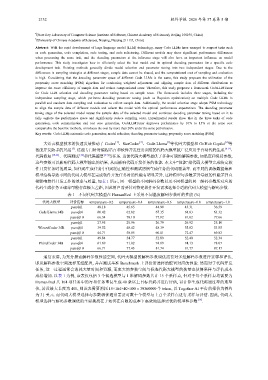
                 接影响软件开发工作的效率与质量, 如表            1  所示, 同一模型的不同解码参数以及不同模型的同一解码参数所对应的
                 代码生成任务正确率可能存在极大差距, 因此用户需要针对特定软件开发需求选择合适的代码大模型与解码参数.

                               表 1 不同代码大模型在        HumanEval 上采用不同温度解码参数时的性能           (%)

                    代码大模型       评价指标     temperature=0.2  temperature=0.4  temperature=0.6  temperature=0.8  temperature=1.0
                                 pass@1     48.18        45.65        44.90        43.31        36.59
                  Code Llama 34B  pass@4    60.42        62.82        67.35        68.83        63.32
                                pass@10     66.34        70.10        77.92        81.02        77.66
                                 pass@1     27.95        28.96        26.79        26.92        25.10
                  WizardCoder 34B  pass@4   39.52        48.42        48.39        55.82        53.85
                                pass@10     44.71        58.05        60.01        72.47        69.82
                                 pass@1     49.84        54.77        52.89        52.40        52.34
                  PhindCoder 34B  pass@4    61.69        71.02        74.19        74.13        78.07
                                pass@10     66.71        77.43        81.74        81.77        87.17

                    通常来讲, 为充分探索解码参数性能空间, 代码大模型的解码参数调优需要对多组解码参数进行采样和评估,
                 即从解码参数空间选择某组配置, 并在测试基准               Benchmark  上评价所选择的配置对应的性能. 然而对于代码开发
                 任务, 这一过程通常会消耗大量时间和资源, 而庞大的参数空间与候选代码大模型的数量也使得采样与评估成本
                 成倍增加. 以表    1  为例, 该表仅包括    3  个候选模型与   1  维解码参数共计     15  个采样点, 但对于每个采样点均需要为
                 HumanEval 共  164  项任务中的每项任务重复生成        40  条以上目标代码并进行评估, 以计算生成代码通过率的期望
                 值, 若设最大长度为      400, 则该表需要消耗    15×164×40×400 = 39360000 个  token, 以  Together AI 平台的报价为例约
                 为  31  美元. 而代码大模型选择与参数调优通常需要对数十个模型与上百个采样点进行采样与评估. 因此, 代码大
                 模型选择与解码参数调优的主要挑战在于如何在有限的成本下高效地选择更优的模型和参数                                [14] .

