


Page 59 - 《软件学报》2026年第3期
P. 59
1022                                                       软件学报  2026  年第  37  卷第  3  期


                 first  stage  rapidly  navigates  from  an  entry  point  to  a  region  near  the  query  vector,  while  the  second  stage  searches  for  the  k  nearest
                 vectors within the localized region. However, due to the need to store a large number of adjacency relationships, graph-based indexes often
                 incur  high  memory  overhead.  In  practice,  this  leads  to  storing  the  index  in  external  memory,  where  vector  and  graph  data  are  loaded  on
                 demand  during  ANNS.  This  results  in  frequent  I/O  operations,  which  have  become  the  primary  bottleneck,  accounting  for  over  90%  of
                 total  query  time.  Existing  systems  exploit  the  fact  that  entry  points  and  their  nearby  neighbors  are  frequently  accessed,  and  adopt  static
                 caching  strategies  that  preload  these  points  and  their  multi-hop  neighbors  into  memory  to  reduce  I/O  during  the  first  stage.  However,  this
                 study  finds  that  the  second  stage  contributes  the  majority  of  I/O  cost,  as  it  involves  accessing  a  large  number  of  graph  vertices  related  to
                 the  query  vector  to  ensure  high  recall.  Since  the  accessed  vertices  in  this  stage  vary  dynamically  with  each  query,  static  caching  strategies
                 fail  to  capture  them  effectively  and  thus  become  nearly  ineffective.  To  address  this  issue,  a  hybrid  caching  strategy  termed  GoVector  is
                 proposed, which integrates both static and dynamic components. Specifically, (1) the static cache preloads the entry point and its frequently
                 accessed  neighbors,  while  (2)  the  dynamic  cache  adaptively  stores  high-locality  vertices  encountered  during  the  second  stage  of  the  search.
                 Furthermore,  to  align  with  the  similarity-driven  search  behavior  of  the  second  stage,  a  vector-similarity-aware  disk  layout  strategy  is
                 proposed,  which  reorganizes  the  storage  order  of  vertices  to  cluster  similar  vectors  into  the  same  or  adjacent  disk  pages,  thus  enhancing
                 data  locality.  This  dual-optimization  approach  significantly  improves  cache  hit  rates  and  effectively  reduces  overall  I/O  overhead.
                 Experimental  results  on  multiple  public  datasets  demonstrate  that,  under  90%  recall,  GoVector  achieves  an  average  of  46%  fewer  I/O
                 operations, 1.73× higher query throughput, and 42% lower latency compared to state-of-the-art disk-based graph indexing ANNS systems.
                 Key words:  high-dimensional vector; approximate nearest neighbor search (ANNS); graph-based index

                    随着大语言模型 (large language model, LLM) 等生成式人工智能技术的迅速发展, 向量化语义检索在自然语
                 言处理  [1,2] 、信息检索  [3,4] 和推荐系统  [5,6] 等多个应用中起到关键作用. 特别是在检索增强生成 (retrieval-augmented
                 generation, RAG) 技术中, 向量语义检索已成为提升生成质量与响应效率的关键机制                  [7] . 为了应对高维向量检索的
                 复杂性  [8] , 近似最近邻搜索 (approximate nearest neighbor search, ANNS) 技术得到广泛应用, 其中基于图的索引方
                           [9]
                 法, 如  HNSW 、NSG  [10] 、DiskANN  [11] 等凭借低延迟、高精度与高吞吐量的特点, 受到学术界和工业界的广泛关
                 注  [12−15] . 然而, 索引图需显式存储大规模向量之间的邻接关系, 导致索引本身消耗大量存储空间. 随着向量规模不
                 断扩大, 将全部索引常驻于内存变得代价高昂, 因此越来越多的系统采用基于磁盘的                           ANNS  方案, 将索引图部分
                 或全部存储在磁盘中, 以降低内存压力并提升系统可扩展性                   [11,16] . 其中, 以  DiskANN  为代表的基于磁盘的索引图
                 技术被广泛集成于业界高性能向量数据库系统 (如                Pinecone [17] 、Milvus [18] ) 中, 以支持千亿规模向量数据的高效检
                 索. 这类方法的核心是从入口顶点开始拓展, 每次从磁盘中加载拓展顶点所在的磁盘页 (page), 以获取其向量信息
                 及邻接顶点, 并根据邻接顶点与查询向量的距离选择下一次的拓展顶点.
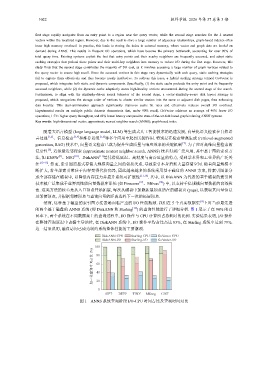
                    然而, 这种基于磁盘的索引图方法普遍面临严重的                 I/O  性能瓶颈. 我们在   5  个真实数据集    [8] 上对当前最先进
                 的两个基于磁盘的       ANNS  系统 (即  DiskANN  和  Starling [16] ) 的查询性能进行了详细分析. 图  1  展示了在  90%  的召
                 回率下, 两个系统在不同数据集上的查询过程中, I/O             操作与   CPU  计算所占总耗时的比例. 实验结果表明, I/O          操作
                 在整体查询延迟中占据主导地位, 在            DiskANN  系统中, I/O  操作平均占比高达     83%, 在  Starling  系统中达到  79%.
                 这一结果说明, 磁盘访问已成为制约系统整体性能的主要瓶颈.

                                              DiskANN-CPU  Starling-CPU  GoVector-CPU
                                              DiskANN-I/O  Starling-I/O  GoVector-I/O
                                          归一化查询时间占比 (%) 100
                                            80

                                            60
                                            40
                                            20

                                             0
                                                SIFT  DEEP  TINY  MSong  GIST
                                    图 1 ANNS   系统查询阶段     I/O-CPU  时间占比及查询时间对比

