


Page 169 - 《软件学报》2026年第3期
P. 169
1132                                                       软件学报  2026  年第  37  卷第  3  期


                 运算符用于计算距离. 该运算符与           ORDER BY  子句一起集成到查询中, 便于根据计算的距离按升序对结果排序.
                 为了进一步细化输出, 应用了         LIMIT  子句, 将结果限制为前     k 个空间对象.

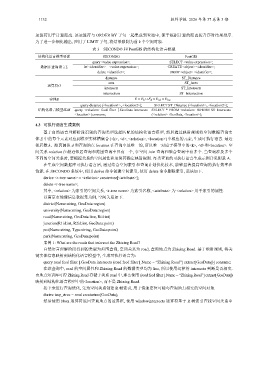
                                          表 3 SECONDO   和  PostGIS  的结构化语言模型

                  结构化语言模型要素                    SECONDO                             PostGIS
                                          query <value expression>;         SELECT <value expression>;
                   数据库查询语言L           let <identifier> = <value expression>;  CREATE <object> <identifier>;
                                            delete <identifier>;            DROP <object> <identifier>;
                                                distance                          ST_Distance
                                                 area                              ST_Area
                      运算符O
                                               intersects                         ST_Intersects
                                               intersection                      ST_Intersection
                       实体E                                   E = E k ∪ E d ∪ E rel ∪ E loc
                                     query distance (<location1>, <location2>);  SELECT ST_Distance (<location1>, <location2>);
                  结构化语言模型SLM      query  <relation>  feed  filter  [.GeoData  intersects SELECT * FROM <relation> WHERE ST_Intersects
                                  <location>] consume;              (<relation> .GeoData, <location>);

                  4.3   可执行语言生成案例
                    基于自然语言理解阶段识别的查询类型选择匹配的结构化语言模型, 然后通过映射规则将空间数据查询实
                 体  E  中的每个元素对应到模型实体槽集合{<k>, <d>, <relation>, <location>}中相应的元素, 生成可执行语言. 最近
                 邻居数   k、距离阈值    d  和查询地点   location  在查询中是唯一的, 所以唯一对应于模型中的<k>, <d>和<location>. 空
                 间关系   relation  在最近邻居查询和范围查询中只有一个, 在空间            Join  查询和聚合查询中有多个. 当查询涉及多个
                 不同的空间关系时, 要根据关系的空间属性和运算符确定映射规则. 每类查询的可执行语言生成示例详见附录                                   A.
                    在生成空间数据库可执行语言后, 通过结合空间索引和查询计划优化技术, 能够显著提高查询的执行效率和
                 性能. 在  SECONDO  系统中, 使用   derive 命令创建空间索引, 使用     delete 命令删除索引, 语法如下.
                    derive <r-tree name> = <relation> creatertree[<attribute>];
                    delete <r-tree name>;
                    其中, <relation> 为索引的空间关系, <r-tree name> 为索引名称, <attribute> 为 <relation> 用于索引的属性.
                    以南京市地理信息数据集为例, 空间关系如下.
                    district(Name:string, GeoData:region)
                    university(Name:string, GeoData:region)
                    road(Name:string, GeoData:line, Rid:int)
                    junction(R1id:int, R2id:int, GeoData:point)
                    poi(Name:string, Type:string, GeoData:point)
                    park(Name:string, GeoData:point)
                    案例  1: What are the roads that intersect the Zhixing Road?
                    自然语言理解阶段得到的类型为范围查询, 空间关系为                   road, 查询地点为   Zhixing Road. 基于映射规则, 将关
                 键实体信息映射到结构化语言模型中, 生成可执行语言为:
                    query road feed filter [.GeoData intersects (road feed filter [.Name = “Zhixing Road”] extract[GeoData])] consume;
                    在该查询中, road   的空间属性和     Zhixing Road  的数据类型均为   line, 所以使用运算符    intersects 判断是否相交.
                 由地点知识库可得      Zhixing Road 存储于关系  road 中, 那么使用 (road feed filter [.Name = “Zhixing Road”] extract[GeoData])
                 映射到结构化语言模型中的<location>, 而不是         Zhixing Road.
                    接下来进行查询优化, 先为空间关系创建             R  树索引, 用于快速定位可能与查询地点相交的空间对象.
                    derive tmp_rtree = road creatertree[GeoData];
                    然后使用    bbox  运算符返回查询地点的边界框, 使用          windowintersects 运算符基于  R  树索引查找空间关系中

