


Page 138 - 《软件学报》2026年第3期
P. 138
王可 等: 面向批量更新的向量索引召回率优化                                                          1101


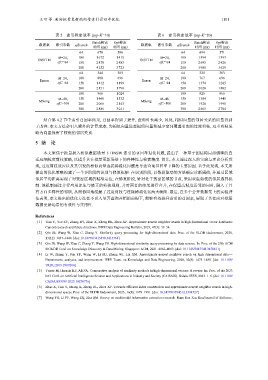
                          表 5 索引检索效率 (top-K=10)                        表 6 索引检索效率 (top-K=20)

                                          Batch检索   Opt检索                              Batch检索   Opt检索
                  数据集     索引参数    efSearch                      数据集    索引参数     efSearch
                                          时间 (ms)  时间 (ms)                              时间 (ms)  时间 (ms)
                                    64      678      586                          64      694     571
                           M=24,    100     1 672    1 415              M=24,    100     1 594    1 393
                  GIST1M                                       GIST1M
                           efC=64   150     2 878    2 483              efC=64   150     2 695    2 426
                                    200     4 252    3 723                       200     3 981    3 629
                                    64      344      303                          64      329     303
                           M=24,    100     800      696                M=24,    100      767     696
                   Enron                                        Enron
                           efC=64   150     1 412    1 199              efC=64   150     1 374    1 205
                                    200     2 151    1 798                       200     2 028    1 802
                                    100     966      1 024                       100      926     966
                           M=48,    150     1 460    1 532              M=48,    150     1 384    1 441
                  MSong                                         MSong
                          efC=100   200     2 066    2 143             efC=100   200     1 928    1 991
                                    300     2 886    3 011                       300     2 665    2 704

                    结合第   4.2  节中索引召回率结果, 召回率得到了提升, 查询时长减少, 因此, 相似向量的邻居关系的质量得到
                 了改善. 本文方法会引入额外的计算成本, 为相似向量选择枢纽向量和减少空间覆盖引起的过度剪枝, 双重剪枝策
                 略为向量保留了较优的邻居关系.

                  5   结 论

                    本文聚焦于批量插入相似数据场景下              HNSW  索引的召回率退化问题, 提出了一种基于图结构局部调整的自
                 适应细粒度剪枝策略, 以提升其在批量更新场景下的鲁棒性与检索精度. 首先, 本文通过深入的实验与理论分析发
                 现, 过度剪枝效应以及其引发的相似向量连接稀疏化问题是导致查询召回率下降的主要原因. 基于此发现, 本文所
                 提出的优化策略构建了一个多阶段的识别与修复框架: 在识别阶段, 以数据驱动的方法确定诊断阈值, 并通过区域
                 邻居平均距离实现了对致密区域的精准定位; 在修复阶段, 针对处于致密区域的节点, 采用双重剪枝的邻居选择机
                 制. 该机制通过并行应用原生与修正的剪枝规则, 并对两者的结果进行合并, 在保留高精度近邻的同时, 融入了具
                 有方向多样性的邻居, 从而协同地缓解了过度剪枝与连接稀疏化这两大缺陷. 最后, 在多个公开数据集上的实验评
                 估表明, 本文提出的优化方法在不引入显著查询开销的前提下, 能够有效提升索引的召回率, 展现了其在面对批量
                 数据更新场景的有效性与实用性.


                 References
                  [1]   Tian Y, Yue ZY, Zhang RY, Zhao X, Zheng BL, Zhou XF. Approximate nearest neighbor search in high dimensional vector databases:
                     Current research and future directions. IEEE Data Engineering Bulletin, 2023, 47(3): 39–54.
                  [2]   Qin  JB,  Wang  W,  Xiao  C,  Zhang  Y.  Similarity  query  processing  for  high-dimensional  data.  Proc.  of  the  VLDB  Endowment,  2020,
                     13(12): 3437–3440. [doi: 10.14778/3415478.3415564]
                  [3]   Qin JB, Wang W, Xiao C, Zhang Y, Wang YS. High-dimensional similarity query processing for data science. In: Proc. of the 27th ACM
                     SIGKDD Conf. on Knowledge Discovery & Data Mining. Singapore: ACM, 2021. 4062–4063. [doi: 10.1145/3447548.3470811]
                  [4]   Li  W,  Zhang  Y,  Sun  YF,  Wang  W,  Li  MJ,  Zhang  WJ,  Lin  XM.  Approximate  nearest  neighbor  search  on  high  dimensional  data —
                     Experiments, analyses, and improvement. IEEE Trans. on Knowledge and Data Engineering, 2020, 32(8): 1475–1488. [doi: 10.1109/
                     TKDE.2019.2909204]
                  [5]   Yasser M, Hussain KF, Ali SA. Comparative analysis of similarity methods in high-dimensional vectors: A review. In: Proc. of the 2023
                     Int’l Conf. on Artificial Intelligence Science and Applications in Industry and Society (CAISAIS). Galala: IEEE, 2023. 1–6. [doi: 10.1109/
                     CAISAIS59399.2023.10270776]
                  [6]   Zhao X, Tian Y, Huang K, Zheng BL, Zhou XF. Towards efficient index construction and approximate nearest neighbor search in high-
                     dimensional spaces. Proc. of the VLDB Endowment, 2023, 16(8): 1979–1991. [doi: 10.14778/3594512.3594527]
                  [7]   Wang YS, Li PF, Wang ZQ, Zhu QM. Survey on multimodal information extraction research. Ruan Jian Xue Bao/Journal of Software,

