


Page 143 - 《软件学报》2026年第2期
P. 143
622                                                        软件学报  2026  年第  37  卷第  2  期


                 root  cause  analysis.  However,  mainstream  score  function-based  intervention  identification  is  often  limited  by  the  score  function  estimation
                 step. The analytical solutions used in existing methods struggle to effectively model the real distribution of high-dimensional complex data.
                 In  light  of  recent  advances  in  data  generation,  this  study  proposes  a  diffusion  model-guided  root  cause  analysis  strategy.  Specifically,  the
                 proposed  method  first  estimates  the  score  functions  corresponding  to  data  distributions  before  and  after  the  anomaly  using  diffusion
                 models.  It  then  identifies  the  set  of  root  cause  variables  by  observing  the  variance  of  the  first-order  derivatives  of  the  overall  score
                 function  after  weighted  fusion.  Furthermore,  to  solve  the  issue  of  computational  overhead  raised  by  the  pruning  operation,  an  acceleration
                 strategy  is  proposed  to  estimate  the  score  function  from  the  initially  trained  diffusion  model,  avoiding  the  re-training  cost  of  the  diffusion
                 model  after  each  pruning  operation.  Experimental  results  on  simulated  and  real-world  datasets  demonstrate  that  the  proposed  method
                 accurately  identifies  the  set  of  root  cause  variables.  Furthermore,  ablation  studies  show  that  the  guidance  provided  by  the  diffusion  model
                 is critical to the improved performance.
                 Key words:  root cause analysis (RCA); diffusion model; structural causal model (SCM)

                    根因分析 (root cause analysis, RCA) 指的是结合异常发生前后的数据, 对系统中引起异常的根本原因进行定
                 位  [1–5] , 在识别引起系统故障的起因中起着至关重要的作用. 事实上, 现实世界中的复杂系统出现故障, 往往会造成
                 严重的影响    [4] . 如图  1(a) 所示, 为了确保云服务系统的可靠性和稳健性, 系统维护者通常会收集和分析关键性能指
                 标如延迟、CPU/内存使用等度量数据和日志数据, 以定位可能出错的原因                      [3] . 然而, 大型复杂系统的复杂性和大量
                 的监控数据使得手动分析根因变量这一过程既昂贵又容易出错. 因此, 如何实现快速有效的根因分析对于快速恢
                 复系统服务、减少异常损失、确保大型复杂系统的持续运行至关重要                        [6–8] .

                   10                           20.0                          20.0
                                                17.5                          17.5
                    8                           15.0                          15.0
                   异常值推荐  6 4                  异常值推荐  12.5                   异常值推荐  12.5
                                                                              10.0
                                                10.0
                                                 7.5
                                                 5.0                           7.5
                                                                               5.0
                    2
                                                 2.5                           2.5
                    0                             0                             0
                    数据库服务 储存服务  计算服务  网络服务 手机云服务  数据库服务 储存服务  计算服务  网络服务 手机云服务  数据库服务 储存服务  计算服务  网络服务 手机云服务
                              服务类别                          服务类别                          服务类别

                 数据库服务                         数据库服务                         数据库服务
                         计算服务 网络服务 手机云服务              计算服务 网络服务 手机云服务                计算服务 网络服务手机云服务
                   储存服务                          储存服务                         储存服务
                        (a) 计算服务流程示意图               (b) 相关性驱动的根因分析                  (c) 因果驱动的根因分析
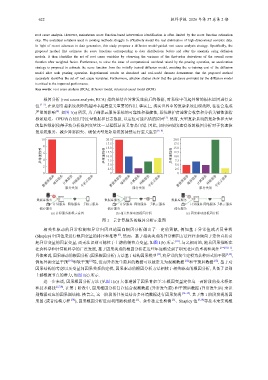
                                              图 1 云计算服务的根因分析示意图

                    相关性驱动的异常检测和异常归因理论面向根因分析做出了一定的贡献, 例如基于异常值或者夏普利
                 (Shapley) 归因值来进行根因变量的排序和推荐          [9] . 然而,基于相关关系的异常溯因方法往往会倾向于定位直接引
                 起异常变量的因素变量, 而无法识别可能位于上游的根节点变量, 如图                      1(b) 所示  [10] . 与之相对地, 随着因果推断在
                 社会科学和计算机科学的广泛发展, 基于因果关系的根因分析在近些年逐渐受到了研究社区的重视和关注                                   [1–4,10,11] .
                 具体来说, 因果驱动的根因分析         (因果根因分析) 方法基于结构因果模型           [12] , 将异常的发生建模为某种形式的干预       [3,10] ,
                 例如外源变量干预      [10] 和软干预  [3] 等, 进而异常发生前后的数据可以被定义为观测数据             [12] 和干预后数据  [12] . 鉴于对
                 因果结构的考虑以及变量间因果关系的建模, 因果驱动的根因分析方法相较于相关驱动的根因分析, 具备了识别
                 上游根源节点的潜力, 如图        1(c) 所示.
                    进一步来说, 因果根因分析方法           (见图  1(c)) 大都遵循了因果骨架学习-根因变量定位这一两阶段的技术框架
                 和技术路线    [5,7,8] . 在第  1  阶段中, 因果根因分析旨在结合观测数据      (异常发生前) 和干预后数据        (异常发生后) 来识
                 别数据对应的因果图结构. 换言之, 这一阶段的任务是结合多环境数据进行因果发现                          [13−15] . 基于第  1  阶段发现的因
                 果图  (或者结构方程    [10] ), 因果根因分析进而利用随机游走       [1] 、条件独立性检测    [3] 、Shapley  值  [9,10] 等技术来实现根

