


Page 302 - 《软件学报》2025年第8期
P. 302
赵浩钧 等: 基于   BERT  与自编码器的概念漂移恶意软件分类优化                                            3725


                     00020]
                 [30]  Zhang MH, Cui ZC, Neumann M, Chen YX. An end-to-end deep learning architecture for graph classification. In: Proc. of the 32nd
                     AAAI Conf. on Artificial Intelligence, the 30th Innovative Applications of Artificial Intelligence Conf. and the 8th AAAI Symp. on
                     Educational Advances in Artificial Intelligence. New Orleans: AAAI Press, 2018. 4438–4445.
                 [31]  Jordaney  R,  Sharad  K,  Dash  SK,  Wang  Z,  Papini  D,  Nouretdinov  I,  Cavallaro  L.  Transcend:  Detecting  concept  drift  in  malware
                     classification models. In: Proc. of the 26th USENIX Security Symp. Vancouver: USENIX Association, 2017. 625–642.
                 [32]  Alvares J, di Troia F. BERT for malware classification. In: Stamp M, Visaggio CA, Mercaldo F, Di Troia F, eds. Artificial Intelligence
                     for Cybersecurity. Cham: Springer, 2022. 161–181. [doi: 10.1007/978-3-030-97087-1_7]
                 [33]  Oak R, Du M, Yan D, Takawale H, Amit I. Malware detection on highly imbalanced data through sequence modeling. In: Proc. of the
                     12th ACM Workshop on Artificial Intelligence and Security. London: ACM, 2019. 37–48. [doi: 10.1145/3338501.3357374]
                 [34]  Vincent P, Larochelle H, Lajoie I, Bengio Y, Manzagol PA. Stacked denoising autoencoders: Learning useful representations in a deep
                     network with a local denoising criterion. The Journal of Machine Learning Research, 2010, 11: 3371–3408.
                 [35]  MalwareBazaar Homepage. 2021. https://bazaar.abuse.ch/
                 [36]  Sebastián M, Rivera R, Kotzias P, Caballero J. AVClass: A tool for massive malware labeling. In: Proc. of the 19th Int’l Symp. on
                     Research in Attacks, Intrusions, and Defenses. Paris: Springer, 2016. 230–253. [doi: 10.1007/978-3-319-45719-2_11]
                 [37]  Joe security LLC. Joe security. 2022. https://www.joesecurity.org/
                 [38]  Wadkar M, Di Troia F, Stamp M. Detecting malware evolution using support vector machines. Expert Systems with Applications, 2020,
                     143: 113022. [doi: 10.1016/j.eswa.2019.113022]
                 [39]  Manku GS, Jain A, Das Sarma A. Detecting near-duplicates for Web crawling. In: Proc. of the 16th Int’l Conf. on World Wide Web.
                     Banff Alberta: ACM, 2007. 141–150. [doi: 10.1145/1242572.1242592]
                 [40]  LeCun Y, Boser B, Denker JS, Henderson D, Howard RE, Hubbard W, Jackel LD. Backpropagation applied to handwritten zip code
                     recognition. Neural Computation, 1989, 1(4): 541–551. [doi: 10.1162/neco.1989.1.4.541]
                 [41]  Ji  TT,  Fang  BX,  Cui  X,  Wang  ZR,  Liao  P,  Song  SY.  Framework  for  understanding  intention-unbreakable  malware.  Science  China
                     Information Sciences, 2023, 66(4): 142104. [doi: 10.1007/s11432-021-3567-y]

                 附中文参考文献:
                 [3]  汪嘉来, 张超, 戚旭衍, 荣易. Windows 平台恶意软件智能检测综述. 计算机研究与发展, 2021, 58(5): 977–994. [doi: 10.7544/issn1000-
                    1239.2021.20200964]


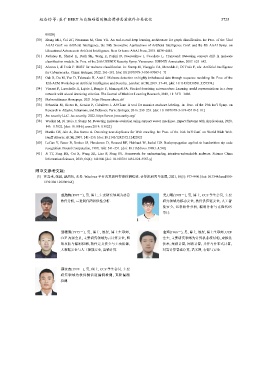
                             赵浩钧(1997-), 男, 博士, 主要研究领域为恶意                 吴月明(1993-), 男, 博士, CCF  学生会员, 主要
                            软件分析, 二进制代码相似性分析.                            研究领域为移动安全, 软件供应链安全, 人工智
                                                                         能安全, 恶意软件分析, 漏洞分析与克隆代码
                                                                         审计.


                             邹德清(1975-), 男, 博士, 教授, 博士生导师,                金海(1966-), 男, 博士, 教授, 博士生导师, CCF
                            CCF  高级会员, 主要研究领域为云计算安全, 网                   会士, 主要研究领域为计算机系统结构, 虚拟化
                            络攻防与漏洞检测, 软件定义安全与主动防御,                       技术, 集群计算, 网格计算, 并行与分布式计算,
                            大数据安全与人工智能安全, 容错计算.                          对等计算普适计算, 语义网, 存储与安全.


                             薛文杰(1999-), 男, 硕士, CCF  学生会员, 主要
                            研究领域为软件侧信道漏洞检测, 克隆漏洞
                            检测.

