


Page 43 - 《高原气象》2026年第5期
P. 43
5 期               季靖骁等:青藏高原东南缘凉山地区雷电流幅值时空分布与概率模型研究                                         1259


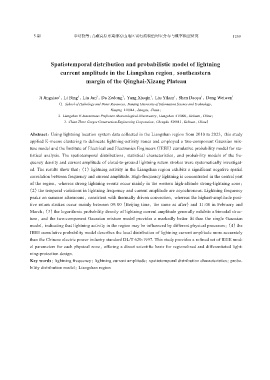
                        Spatiotemporal distribution and probabilistic model of lightning

                            current amplitude in the Liangshan region, southeastern
                                        margin of the Qinghai-Xizang Plateau


                                                                     1
                                                                                1
                                                         3
                                                                                            1
                                             2
                            1
                                    2
                   Ji Jingxiao , Li Bing , Liu Jun , Du Zedong , Yang Xiuqin , Liu Yikun , Shen Daoyu , Deng Weiwen 1
                           (1.  School of Hydrology and Water Resources, Nanjing University of Information Science and Technology,
                                                   Nanjing  210044, Jiangsu, China;
                            2.  Liangshan Yi Autonomous Prefecture Meteorological Observatory, Liangshan  615000, Sichuan, China;
                              3.  China Three Gorges Construction Engineering Corporation, Chengdu  610041, Sichuan, China)
               Abstract: Using lightning location system data collected in the Liangshan region from 2010 to 2023, this study
               applied K-means clustering to delineate lightning-activity zones and employed a two-component Gaussian mix‐
               ture model and the Institute of Electrical and Electronics Engineers (IEEE) cumulative probability model for sta‐
               tistical analysis. The spatiotemporal distributions, statistical characteristics, and probability models of the fre‐
               quency density and current amplitude of cloud-to-ground lightning return strokes were systematically investigat‐
               ed. The results show that: (1) lightning activity in the Liangshan region exhibits a significant negative spatial
               correlation between frequency and current amplitude. High-frequency lightning is concentrated in the central part
               of the region, whereas strong lightning events occur mainly in the western high-altitude strong-lightning zone;
              (2) the temporal variations in lightning frequency and current amplitude are asynchronous. Lightning frequency
               peaks on summer afternoons, consistent with thermally driven convection, whereas the highest-amplitude posi‐
               tive return strokes occur mainly between 09:00 (Beijing time, the same as after) and 11:00 in February and
               March; (3) the logarithmic probability density of lightning current amplitude generally exhibits a bimodal struc‐
               ture, and the two-component Gaussian mixture model provides a markedly better fit than the single Gaussian
               model, indicating that lightning activity in the region may be influenced by different physical processes; (4) the
               IEEE cumulative probability model describes the local distribution of lightning current amplitude more accurately
               than the Chinese electric power industry standard DL/T 620-1997. This study provides a refined set of IEEE mod‐
               el parameters for each physical zone, offering a direct scientific basis for regionalized and differentiated light‐
               ning-protection design.
               Key words: lightning frequency; lightning current amplitude; spatiotemporal distribution characteristics; proba‐
               bility distribution model; Liangshan region

