


Page 175 - 《高原气象》2026年第1期
P. 175
1 期                 范   典等:一次稳定少动型西南涡演变的结构特征及其与暴雨的关系                                       171


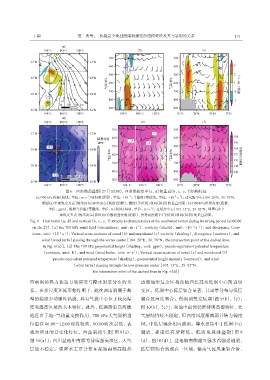
                               图6 西南涡鼎盛期(27日00:00), 西南涡的水平(a, d)和垂直(b, c, e, f)结构特征
                                                             -1
                                                           -4
                                        -1
                                                                                -4
                                                                                  -1
                 (a)700 hPa风场(流线, 单位: m·s )和涡度(阴影, 单位: ×10  s )散度(等值线, 单位: ×10  s ); 过气旋中心[104. 28°E, 30. 78°N,
                    即图(a)中虚线交叉点]的纬向(b)和经向(c)涡度(阴影)、 散度(等值线)和风(风羽)的垂直剖面; (d)700 hPa位势高度(阴影,
                                                                     -1
                       单位: gpm)、 假相当位温(等值线, 单位: K)和风(风羽, 单位: m·s ); 过低压中心[105. 13°E, 29. 82°N, 即图(d)中
                            虚线交叉点]的纬向(e)和经向(f)假相当位温(阴影)、 位势高度距平(等值线)和风(风羽)的垂直剖面。
               Fig. 6 Horizontal (a, d) and vertical (b, c, e, f) structural characteristics of the southwest vortex during its strong period (at 00:00
                                                               -1
                on the 27).(a) the 700 hPa wind field (streamlines, unit: m·s ), vorticity (shaded, unit: ×10⁻⁴ s⁻¹), and divergence (con‐
                tours, unit: ×10⁻⁴ s⁻¹); Vertical cross-sections of zonal (b) and meridional (c) vorticity (shading), divergence (contours), and
                    wind (wind barbs) passing through the vortex center [104. 28°E, 30. 78°N, the intersection point of the dashed lines
                    in Fig. 6(a)]; (d) The 700 hPa geopotential height (shading, unit: gpm), pseudo-equivalent potential temperature
                                                              -1
                    (contours, unit: K), and wind (wind barbs, unit: m·s ); Vertical cross-sections of zonal (e) and meridional (f)
                         pseudo-equivalent potential temperature (shading), geopotential height anomaly (contours), and wind
                                  (wind barbs) passing through the low-pressure center [105. 13°E, 29. 82°N,
                                           the intersection point of the dashed lines in Fig. 6(d)]

               西南涡的热力和动力场演变与降水时空分布的关                             边坡地形复杂区和盆地西北部及低涡中心附近切
               系。在多尺度环流形势作用下, 此次西南涡属于典                           变区。低涡中心低层辐合显著, 其雨带分布与低层

               型的稳定少动暖性涡旋, 具有气旋中心位于较高温                           辐合区高度吻合。低涡调整发展期[图 9(b), (c);
               度和湿度区域的基本特征。此外, 低涡附近高海拔                           图 10(b), (c)], 盆地中南部仍维持强高湿特征, 大
               地区由于地-气热量交换作用, 700 hPa大气假相当                       气层结持续不稳定, 但西南风逐渐减弱并转为偏南

               位温在 06:00 -12:00 时段较高, 00:00 时次最低, 表              风, 中低层辐合相应减弱。降水虽集中于低涡中心
               现出明显的日变化特征。西南涡初生期[图 9(a),                         附近, 强度已有所降低。低涡发展强盛期[图 9

               图 10(a)], 四川盆地中南部为持续强高湿区, 大气                     (d), 图 10(d)], 盆地偏南侧建立强水汽输送通道,
               层结不稳定。强降水主要分布在盆地南部高湿热                             低层强辐合出现在三区域: 偏南气流风速辐合带、

