


Page 231 - 《高原气象》2025年第6期
P. 231
6 期                     张  翔等:黄土高原典型塬区边界层高度反演方法对比研究                                        1639
                                                                 此时可以结合温度或风等其他数据反演的边界层
                                                                 高度进行补充。
                                                                     综上所述, 本研究给出的混合算法可用于研究
                                                                 区边界层高度的反演, 同时, CL51云高仪自身也能
                                                                 提供较好的小时平均边界层高度, 但部分时段边界
                                                                 层高度信息缺失。在利用云高仪开展边界层高度
                                                                 相关研究时, 如对时间分辨率和连续性要求不高
                                                                 时, 可直接采用云高仪提供的小时平均边界层高度
                                                                 数据; 当对数据连贯性及时间分辨率要求较高时,
                                                                 可以采用本研究给出的混合算法反演结果进行补
                                                                 充, 但在使用中需对雨后晴天或连续晴天大气较为
                                                                 干净时(即气溶胶含量低), 以及夜间或早晨存在高
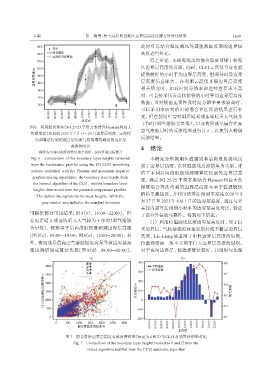
               图6 利用混合算法(SG 25/25平滑方案结合Flamant和最大
                                                                 空气溶胶层时的反演结果进行订正, 以免引入错误
               负梯度法)反演的2023年7月15 -24日边界层高度、 云高仪
                                                                 反演结果。
                 内部算法得到的混合层高度与位温廓线确定的边界层
                                 高度的对比                           4  结论
                   虚线为不同时刻反演结果的平均值, 灰色区域为标准差
               Fig. 6 Comparison of the boundary layer heights retrieved   本研究分别利用位温廓线和后向散射廓线反
               from the backscatter profiles using the SG 25/25 smoothing   演了边界层高度, 以位温廓线反演结果为基础, 评
               scheme combined with the Flamant and maximum negative
                                                                 估了不同后向散射廓线梯度算法反演的边界层高
                gradient mixing algorithms, the boundary layer height from
                                                                 度, 确定 SG 25/25 平滑方案结合 Flamant 和最大负
                the internal algorithm of the CL51, and the boundary layer
                                                                 梯度混合算法得到的边界层高度与基于位温廓线
                heights determined from the potential temperature profiles.
                                                                 的结果最接近, 并利用该算法得到平凉站 2020 年 8
                  The dashed line represents the mean heights, while the
                    gray-shaded area indicates the standard deviation  月 27日至 2023年 8月 1日的边界层高度, 通过与云
                                                                 高仪内部算法得到小时平均边界层高度对比, 验证
               可提供部分可用结果[图 8(b), 16:00 -22:00]。但                 了混合算法的可靠性。得到如下结论:
               在雨后晴天或连续晴天大气较为干净时(即气溶胶                               (1)  利用位温廓线反演边界层高度时, 对于白
               含量低), 较难基于后向散射强度识别边界层高度                           天边界层, 气块法能很好地识别对流不稳定边界层
              [图 8(c), 08:00 -19:00; 图 8(e), 15:00 -20:00], 另    高度, Liu-Liang 法适用于中性边界层高度的识别,
               外, 夜间或早晨高空气溶胶层也容易导致边界层高                           位温梯度法一般不宜用于白天边界层高度的识别。
               度识别错误或算法失效[图 8(d), 08:00 -10:00]。                 对于夜间边界层, 位温梯度法较好, 其结果与比湿


                               图7 混合算法边界层高度有效反演结果(标记为0和2)与CL51自动算法结果对比
                                  Fig. 7 Comparison of the boundary layer height(marked as 0 and 2)from the
                                         mixed algorithm and that from the CL51 automatic algorithm

