


Page 5 - 《爆炸与冲击》2026年第9期
P. 5
第 46 卷         楚紫涵,等: 燃料浓度对受限空间内氢气/空气预混气体爆炸特性的影响                                第 9 期

               30% and 45%, exceeding results at 15% and 60% by 14.6% and 6.3%, respectively. The 30% condition also achieved the peak
               flame area in the shortest time, at 8.2 ms. Furthermore, geometric constraints at the junction of the cylindrical sidewall and the
               endwall led to accumulation of unburned hydrogen, causing localized increases in density and pressure and resulting in four
               clearly discernible high-velocity regions within the flow field. At 9 ms, the flow velocity profile along the centerline exhibited
               symmetry  with  a  dual-peak  structure  appearing  unilaterally.  While  the  45%  condition  showed  an  early  transient  velocity
               advantage due to intensified local heat release, the 30% condition demonstrated superior late-stage velocity recovery owing to
               more stable and sustained combustion near the stoichiometric ratio. These findings underscore the high combustion efficiency
               and stability achievable near stoichiometric conditions, providing a scientific foundation for the design and optimization of
               high-efficiency hydrogen combustion systems.
               Keywords:  confined spaces; hydrogen; fuel concentration; flow velocity

                   在传统化石能源大量使用加剧气候变化                   [1-5]  与“碳达峰、碳中和”       [6]  战略纵深推进的双重驱动下,
               军事能源体系正处于向低碳化转型的关键历史阶段。国际军事气候安全理事会指出国防工业是碳氢化
                                                    [8]
               合物消费的主要领域 ,绿色转型刻不容缓 。在此背景下,氢能作为“零碳能源”                                    [9-10] ,凭借其高质量能
                                 [7]
                                              [9]
               量密度和全生命周期零碳排放特性 ,正逐步替代传统化石能源应用于军事动力系统、战场供能装备等
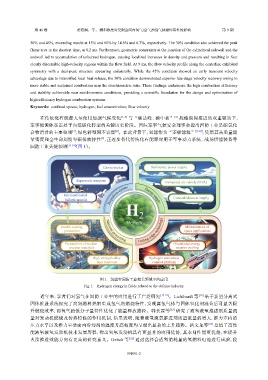
               国防工业关键领域        [11-16] (图  1)。


                                               Carrier rocket       Submarine power supply

                                   Supersonic weapons                     Unmanned air vehicle (UVA)


                              Intercontinental    Propulsion system  Energy supply
                              ballistic missile                               Concealed power supply
                                                         H     2


                                                          Hydrogen
                            Stealth coating                                        Militarization of
                              production        Material processing  Cutting-edge technology  space applications


                              Preparation of nuclear                          Directional energy
                                weapon materials                               weapon cooling

                                          High strength alloy      Hydrogen unmanned
                                            heat treatment           combat platform


                                             图 1    氢能在国防工业相关领域中的应用
                                      Fig. 1    Hydrogen energy in fields related to the defense industry

                   近年来,学者们对氢气在国防工业中的应用进行了广泛研究                           [17-22] 。Lichthardt 等 [10]  基于新型分离式
               固体推进系统探究了高氮燃料热解生成氢气的燃烧特性,发现富氢气体与固体氧化剂混合后可显著提
               升燃烧效率,而氢气的低分子量特性优化了能量释放路径。韩长霖等                                [23]  研究了液氢液氧推进剂质量流
               量对发动机燃烧及传热特性的作用机制,结果表明,随着液氢液氧推进剂质量流量的增大,推力室内的
               压力水平以及推力室壁面内冷却剂的温度升高幅度均呈现出显著的上升趋势。岳文龙等                                         [24]  总结了高性
               能液氧液氢发动机技术发展历程,指出氢氧发动机具有更显著的应用优势,其本身性能更优越,在提升

               火箭推进效能方向有更高的研究意义。Ozbek                   等 [25]  通过选择合适氢消耗量的氢燃料电池进行试验,使


                                                         091001-2

